
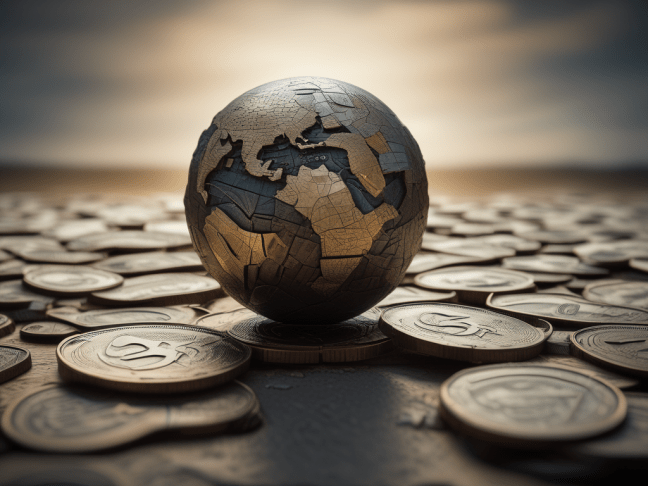
From space, our planet looks like an ever-changing marble. To an alien civilisation, the massive white storm clouds constantly shifting above oceans and landmasses would have probably suggested that this is one messy, stormy, unstable and unwelcoming environment; perhaps one which is on the verge of implosion under all this turmoil. While this may have been true in the days of our planet’s early, stormy history, over the past 3.5 billion years Earth has had plenty of time to figure out, by trial and error, how to achieve the impossible: to balance earth, fire and water, the violent forces which had brought it to life. Somehow this planet achieved what would seem impossible: to develop a climate system and a biosphere which, together, would manage and balance energy, temperature, atmosphere, and even chemical and tectonic processes. Over billions of years this planet eventually achieved the impossible: to manage its own chaos. This incredible feat was no less challenging than a circus artist successfully joggling objects whose weight, size and shape randomly change mid-flight.
The genius in Earth’s approach was to effectively strike a stalemate, rather than a truce, between the planet’s warring elements. It allowed these untamed, wild forces to continue to operate, but within limits, by matching each one with a worthy opponent: volcanic ash released into the atmosphere was matched with lush forests and ocean microorganisms who absorbed volcanic CO2. Incoming solar radiation was matched with blindingly white glaciers which reflected much of it back to space. Temperature differences between regions were matched with giant oceanic currents which transferred heat from the equator to the poles, and water evaporation was matched by torrential rains and rivers which returned water back to its source, the ocean. Like bitter rivals exhausted by war, the Earth’s violent forces were made to sit at the negotiating table, strike treaties with each other, and operate within the finite limits of the planet. The fragile peace which emerged allowed life on the planet to diversify into 10 million species, and enabled the appearance of highly fragile, complex civilisations whose very existence depended on this stalemate. If at any point the stalemate collapsed, so would everything else.
When life emerged, it had no choice but obey the same exact principle of matching opponents: all species were kept in check by each other, locked into predator and prey relationships limited by the availability of chemical energy (food) in the system. Just like the climate, chemical and tectonic forces, the population of each species is limited by a stalemate threshold. Both species and climate patterns compete for energy, whether it is thermal, electrical or chemical. But given that the total energy of the planet does not change, everything is balanced by stalemates. Kilojoules, Watts, Degrees Celsius, ATP, Glucose, Fatty Acids are all acceptable, valid, interconvertible energy currencies of the Bank of Earth. But while energy may freely interconvert between these currencies, the total amount never changes. There is never any leveraging, inflation or deflation. The total size of the energy pie is finite, and constant.
With one exception: humans. Humans were the first species to bring about both an unsustainable population growth, and an unsustainable energy currency: money. Both of these were acts of ecological fraud, as they violated the energy stalemate of the planet. Money is a currency, but unlike all other currencies of the planet it is not in itself energy, but rather an abstract representation of energy. When a bank decides to arbitrarily increase its capitalisation by printing money, this is a fraudulent action which bears no equivalence to the energy which this money is supposed to represent: whether it is the energy an employee has put in, or the biological energy supplied by a bucket of apples. By inventing money, humans had invented a “rogue” energy currency: one that simply does not mathematically compute on this planet.
This of course, was to humans’ advantage. Because by controlling the exchange rate, essentially setting it to whatever they liked, they could get as much energy as they could out of Earth, most of it in fact for free. Humans, as opposed to all other forces and species of the planet, became net energy consumers. Civilisation became a destructive, catabolic process in the ecosystem, sustaining itself through the dismantling of the biosphere and climate system.
This invention of an abstract currency resulted in the concept of profit which, in monetary terms directly translates into Ponzi scheme economics. In energy terms, it means stealing energy that doesn’t belong to you, therefore initiating a domino cascade of violations in all energy stalemates of the planet. Our economic activities, our governing systems and social organisation, our ethics and values, in other words our civilisation, has been molded to accommodate this impossible Ponzi scheme we all subscribed to. From “The feeding of the 5,000” parable in the Bible to the “Jack and the Beanstalk” fairy tale, our religion, culture and bed time stories became narratives of unsustainable economic and population growth which we all believed in as “normal”.
With this level of delusion already in our blood, it was unavoidable that we would soon develop an incredible arrogance, believing that Earth’s resources were there to be exploited by humans. All other species existed for us, not with us. We glorified our crimes, christening ourselves as “conquerors” and “explorers”. In a world obsessed with profit, our heroes became the conquistadors, billionaires, football players and pop stars. As our destructive impacts began to show visible signs, our culture fabricated yet more narratives to cover up its destructiveness. Non-white races were not slaves, they were simply animals being brought in to work. Species weren’t “made extinct”, they “went extinct” by themselves. Natural resources were not exploited or exhausted, they were “extracted” and “utilised”. And we, the participants of this system, became hostages to jobs, salaries and consumption. Companies became hostages to the stock market, which constantly scans their bottom line for any weakness in profitability. Politicians became hostages to economic growth, as opposed to quality of life for their citizens. And climate scientists became hostages to their research grants, avoiding to tell the truth.
We created all these narratives because our Ponzi civilisation wouldn’t be able to continue without them. But this doesn’t mean that any of these narratives are correct. Our civilisation and our economy are fundamentally flawed down to their foundations, because they are built upon a rogue currency. Discovering the concept of stalemates, thresholds and limits by observing how ecosystems and climate systems operate, is the deep understanding which is crucially missing.
George is an author, researcher, molecular biologist and food scientist. You can follow him on Twitter @99blackbaloons
Discover my Books Here
Discover more from George Tsakraklides
Subscribe to get the latest posts sent to your email.
 George Tsakraklides
Dear George,
would there only be a way back! I wouldn’t be able to survive a month with no supermarket, no clothes, no roof. I could certainly survive without my smartphone, but yet I’m typing on it right now. After having read your brilliantly painful email online.
I’m guilty myself and very much so and can provide no redemption, just sadness and love for you and a few people I know.
thank you as ever
Florian
The stalemate metaphor isn’t one I’d heard before, and it’s excellent.