When I was a kid, my parents bought me an illustrated guide to Greek wildflowers. Along with extensive botanical descriptions, there were images of flowers in their natural settings taken by wildflower enthusiasts over the years. Below each blowout image there was the usual information: where the plant may be found, what time of the year it blooms, etc. In some cases, there were even pictures of the plant when not in bloom, so that it can be identified out of season.
I was always particularly drawn to the flowers that were marked as “extremely rare”, endemic, or endangered. In a country with so many islands, mountains and natural barriers, there are hundreds of such species which are confined to extremely small habitats. The rarer and more endangered the flower was, the more it piqued my interest. I would look at the photo, close my eyes and imagine the moment that a lucky botanist had discovered the plant. Some of the pictures were quite old, sometimes with notes indicating that the flower had not been seen in many years, and that this specific photo is one of the few records that exist.
I had seen every page of the book hundreds, thousands of times, to the point where I had almost memorised it: every flower, every petal, every blurry background of mountains with melting pockets of snow, rugged rocks, soil, sky, wilderness. The book became a companion which I would take to family excursions in the countryside like a treasure map, as I tried to find some of these plants. Occasionally I would disappear into the forest and would almost always come across something new I had never seen before.
My passion for collecting and cataloguing life forms had started early on in life with my first seed collection, a type of “Noah’s Arc” for plants much like the Global Seed Vault in Svalbard, Norway which I found out about 30 years later, when I eventually became a plant molecular biologist. The Global Seed Vault is humanity’s only comprehensive seed bank, built underground and into the permafrost layer where temperatures are stable and seeds can be stored for tens, sometimes hundreds of years.
Since the days of treasure maps, flower guides and card catalogues, humanity has come a long way in recording and cataloguing life forms. We “database” everything now: from seeds to books, weather data and traffic patterns, to our own genetic material. Almost everything that exists in the physical world is being captured and converted into digital data: from high-resolution flower pictures to fully sequenced plant DNA. Our entire world is monitored by cameras, catalogued on a continuous basis on a frightening scale which Google, BlackRock and the NSA are unwilling to disclose. The objective is not to understand or catalogue specific things anymore. It is to inhale, engulf, and convert the entirety of the physical world into digits. This is no longer a selective process. It is the creation of a parallel universe, a digital replica of the world for the purposes of artificial intelligence. AI is creating a voodoo doll, a replica of Earth itself: those who own the voodoo doll, get to own and control the real world and the people within it.
But the boundaries between the real world and the voodoo doll are treacherously blurry. The prevalence of data in our lives means that our civilisation is not simply focusing on data. It is literally becoming data. People are morphing into data entities, obsessively curating their multiple online personas. Rather than living beings with flesh and blood, we are existing as electrons, travelling multiple times a day around the Earth through millions of miles of hot cable wire wrapped in plastic which never sees the light of day. Reality is under attack, as we begin to spend more of our lives inhabiting this endless underground cavern every time we dive into our smartphones.
In this new world, we don’t own ourselves anymore. The Voodoo Doll owns us. We are slaves, like a rare flower which has just been discovered and is about to end up in someone’s botanical collection either as a live specimen or dried up for display. People have become biological specimens: data collectibles for companies and governments to monitor, manipulate, monetize and exploit. The Voodoo Doll is replacing the real world.
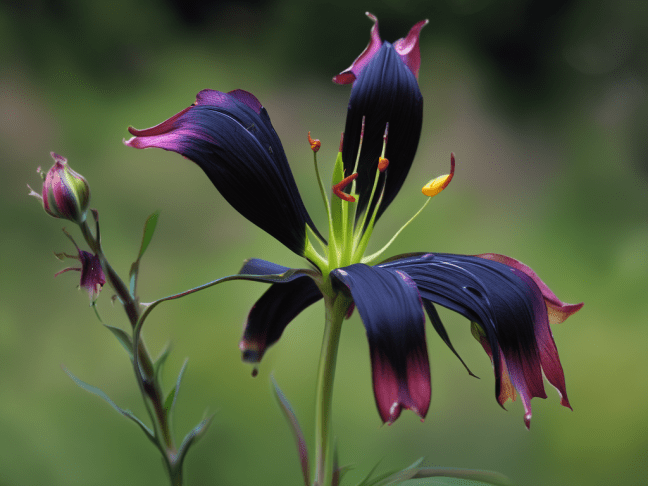
It was a beautiful summer in Greece, and I was just coming on to my early teens. The book’s edges were beginning to get fuzzy, and some pages were completely loose. But I still held on to it tightly. We took the car to one of our favourite summer spots up on a mountain where we collected wild blackberries, strawberries and raspberries for jam. On a random stop along the road, I followed my instinct to trek down a valley that was clearly inaccessible to humans. Heavily covered in thick vegetation and without a walkable path, the valley was calling me in. Me and my father slowly descended through the dark forest and eventually reached the bottom of the valley, into a small but bright clearing. There were bright yellow-green giant ferns all over, taller than humans. And as I pushed the ferns aside, there was something else: emerging out of the fluorescent green ferns there were huge black martagon lilies, the most beautiful and strange flower I had ever seen. I immediately recognised it from my book, its image having been etched in my memory since childhood. For a minute I thought I had actually fallen into the book. My heart started beating loud and I could feel the blood rushing to my face as I realised I had made my “big discovery”. As I approached the rare specimen, I was captivated. Its strange, shiny curved black petals were hairy, almost like an animal, something that the photos had failed to capture. My father urged me to hurry up as it was soon getting dark. We got the shovels out, and picked up one of the plants to carry it back home. We stole the lily from the depths of the cool, magical fern forest, and brought it to the dry and hot balcony of our city apartment. I didn’t know much about caring for plants back then, especially wild plants that need the conditions of their natural habitat to be matched, if they are to survive. The lily died in captivity on that ugly urban balcony, surrounded by concrete and a salty coastal breeze that was a far cry from the nourishing morning summer dew of the mystical valley. And I learned my lesson to never treat another organism as an object again, as a trophy to capture, own and exhibit for my own pleasure and satisfaction.
Humanity’s obsession with ownership and objectification of our world is reaching its ultimate peak, enabled by the information revolution. Rather than protecting the lily and acknowledging its rights, we are quick to own it, use it, buy and sell it, because this is now the purpose of everything in human society: ownership, control, monetisation, power and profit. Even if I had managed to keep the lily alive, I would still never have an appreciation for the wonder that it was: the sunrises and sunsets it had seen in the forest. The many insects that its curled flowers had sheltered from time to time, allowing them to sleep over. The dewdrops that formed and evaporated. The years that it took for that lily to grow from seed, before it can grow a large bulb and eventually flower. Ownership is an action of obliteration, simply because the owner can never truly appreciate what it is that they are owning. Once something is owned, it has effectively died.
The Voodoo Doll is a supermarket, a prison that man is creating: an endless, lifeless desert where things, people, animals, memories and feelings become data, then vanish and die from the real world. The more we try to capture and control, the more we are destroying the planet. Even the Svalbard Global Seed Vault is now under threat, melting because of the climate crisis. The irony of this civilisation is that the more humanity tries to capture, own, and hold on to things, the more ignorant it becomes of them. This is because owned things are always taken for granted. They are forgotten, neglected and disrespected, eventually sold off in a boot sale or thrown into a bonfire.
George is an author, researcher, molecular biologist and food scientist. You can follow him on Twitter @99blackbaloons
Discover my Books Here
Discover more from George Tsakraklides
Subscribe to get the latest posts sent to your email.
 George Tsakraklides
dearheart, George, the timing of your tragic and beautiful piece touches my heart so deeply. And my deep grief of all that you’ve described. I’ve a lot to share.
I’m no longer in London. I’ve moved back to my place of birth, and I do have to travel to London fairly often. Can we connect again? I’d love to.
and at the end of September, I’ll revisit the place where the waters came down on the city..
WhatsApp?
Tamara ❤
Great to hear from you Tamara, sorry I’ve been quiet. It’s been intentional to isolate myself. I’m living in Greece. Hope you’re well, sure let’s WhatsApp
Thank you George for the metaphors and the time you take to share out your thoughts.
Thank you