
One of the biggest detriments of consumatronic culture was how it rapidly obliterated human capacity for revelling in the joy of waiting: instantaneous access to food, transport, and information didn’t just spoil us. It destroyed our relationship with time and resources, and disabled some of the most vital parts of human consciousness.
Farmers used to wait for months for rain to water their crops. Passengers used to wait days for their arrival at their destination. And spouses waited weeks for a letter from their loved one. “Good things come to those who wait” became a popularised wisdom, but it had a double meaning: good things do not come necessarily because we wait, they can also come directly from the act of waiting itself: waiting is one of the most potent mind meditations in patience, perseverance, acceptance, compromise, gratitude, and grief. Waiting teaches us all the above. As waiting dies, all this wisdom dies with it.
In a system that must extract, consume and destroy around the clock, the act of waiting has become a sin, and those who have the audacity to wait are enemies of “the economy”. Workers are told that “the client wanted their report yesterday”, and they bring this dogma home with them: they order junk food because they can’t wait to cook. They take drugs because they can’t wait for true happiness. And they hook up with their secretary in the office, because they can’t wait to get home and have sex with their “life partner”.
Waiting used to be an art form. Capitalism turned it into a “system outage”.
Society became a frenetic drive-thru convenience store where people quickly exchanged consumables without exchanging glances. For most of us life became an anonymous, automatic existence where each day is a box-ticking exercise, each activity a chore, and each human interaction a transaction. The irony of modern civilisation is that the more waiting time humans eliminated from their tasks, the less they could wait before they could complete them. The complexity, repetition and oversaturation that came with this pointless transactional existence depleted the world’s serotonin reserves and led to a collective epidemic of anxiety and depression.
I always look to my garden to remind me, to teach me, the art of patience. I draw strength from how incredibly patient my plants are. As I watch them wait patiently for spring, I notice how their metabolic systems slow down, consolidate and reorganise as they save resources. Spring on the other hand, is the time when they spend exuberantly as their biological factories devote energy not only to growth, but to developing millions of incredible chemicals: hormones, pigments, essential oils. There is so much energy from the sun to draw on, and their roots are so much happier in the warmer soil. In the summer, it is time to draw down again, as the mediterranean heat becomes a burden on the life-support system of the plant. Everything slows down, or even shuts down completely.
These incredible, alternating seasonal cycles of waiting and conserving on one hand, then rushing and spending, is the blueprint for how any sustainable economy should work. Unlike my garden, human economies are always quick to cash in on future rewards that they haven’t earned yet: they harvest fruit that isn’t ready, collect water from rivers that are almost dry, and tax people that they owe money to. The result is natural destruction and inequality.
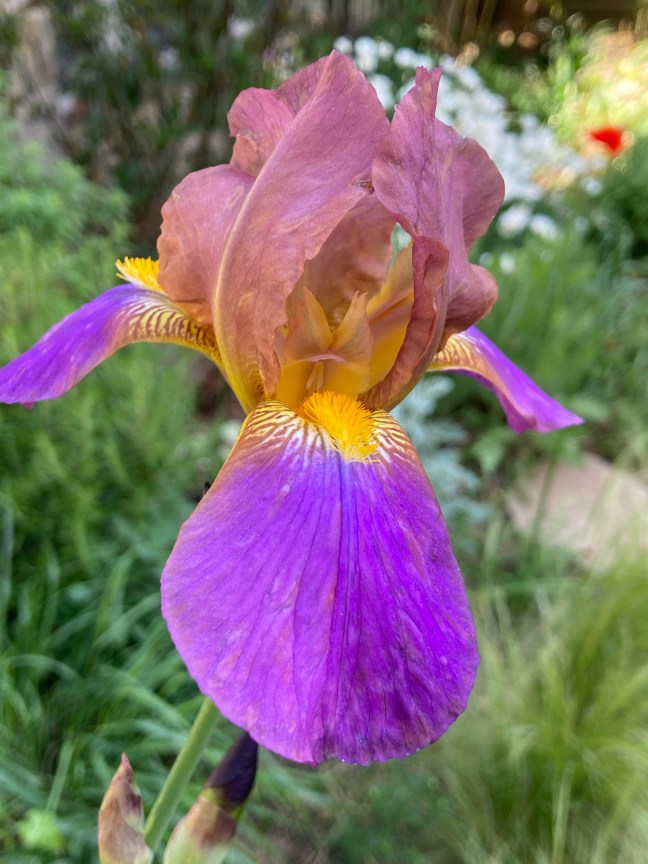
Out of all my plant teachers, the bearded iris is one of the most special – not because it has one of the most other-worldly, beautiful flowers, but because its metabolic system is one of the most peculiar, complicated and unique examples of patience, resilience, and careful, delicate management of resources. Irises are notorious for failing to bloom, because they will only do so if the energy storage economics within their rhizomes perfectly align with a number of environmental and temporal conditions. This complex set of criteria that govern the reproductive decision ensure not only that the plant has the energy to produce a flower, but that this flower will develop fully and mature into the proper size and shape. This is why, unlike other plants, you will never see a bearded iris flower that looks underdeveloped, misshapen, or faded. The iris runs a tight ship. Every single flower is made to perfection.
The bearded iris (Iris germanica) has a rather unusual life cycle: it flowers in late spring, but the development of its flowering structures, the flower “embryo”, begins well before spring. In fact, it begins about 9 months earlier, the previous summer, and right when the plant is under severe drought, temperature stress, and has probably entered dormancy. So, although for most plants the decision to flower is an impulsive one that occurs at the peak of energy availability, for irises this decision takes place 9 months in advance, and during an energy-poor period for the plant. Why would the iris do this?
Irises decide to reproduce based on calculation, not speculation: unlike humans, evolution prudently selected irises to make their reproductive decisions based on the energy they already have in their rhizome, not the energy they may gain in the future. Only rhizomes that are still energy-rich during the most stressful period in the plant’s lifecycle i.e. the rhizomes that have made it through the worst, are able to form flower embryos.
As it makes its decision to reproduce or not, the plant takes into consideration the energy stored inside the rhizome, the energy coming in, and the energy going out. The iris has full metabolic memory. The 9-month gestation period that follows, which is equal to that of a human embryo, is a second big test for the developing flower: it can be aborted at any point. In northern climates pour drainage, excess moisture and decreased sunlight are often the reasons for sterile irises. In my mediterranean climate, lack of adequate moisture in summer and excessive heat can shut down the plant’s metabolism right at the point where it is making its reproductive decision.
As I learn something new each year about how to take care of irises in a climate that accelerates towards disaster, my own metabolism is hopelessly trying to align with, and keep up with, the wisdom of these plants. I am learning to wait, to observe, and conserve, before making decisions. I am learning to use my memory of what I earned, and what I spent – whether it was money, food, sunlight, blood, sweat, or tears.
Because there is beauty in having to wait: the beauty of the perfectly formed flower. Natural systems make decisions based on resources already accumulated, whereas human economic systems never wait: they spend against rewards they haven’t yet earned.
This civilisation never developed a metabolic memory. As it takes apart the life support systems of the planet, it continues to spend more, while it earns less each year. It is producing flowers that will wilt before they mature, and it is incredibly forgetful. If only, it had a fraction of the memory of irises.
You may have noticed the paywalls on my newsletter.
They are not there to deprive you of insight, turn my readership into an exclusive club for the wealthy, or demonstrate how greedy I am.
They are there for a much simpler reason: the paywall is what pays my electric bill and allows me to continue writing.
Those of you who have become paid subscribers deserve the exclusive access to my archive that you have. Without your support, there would be no newsletter at all.
Thank you.
Discover more from George Tsakraklides
Subscribe to get the latest posts sent to your email.

