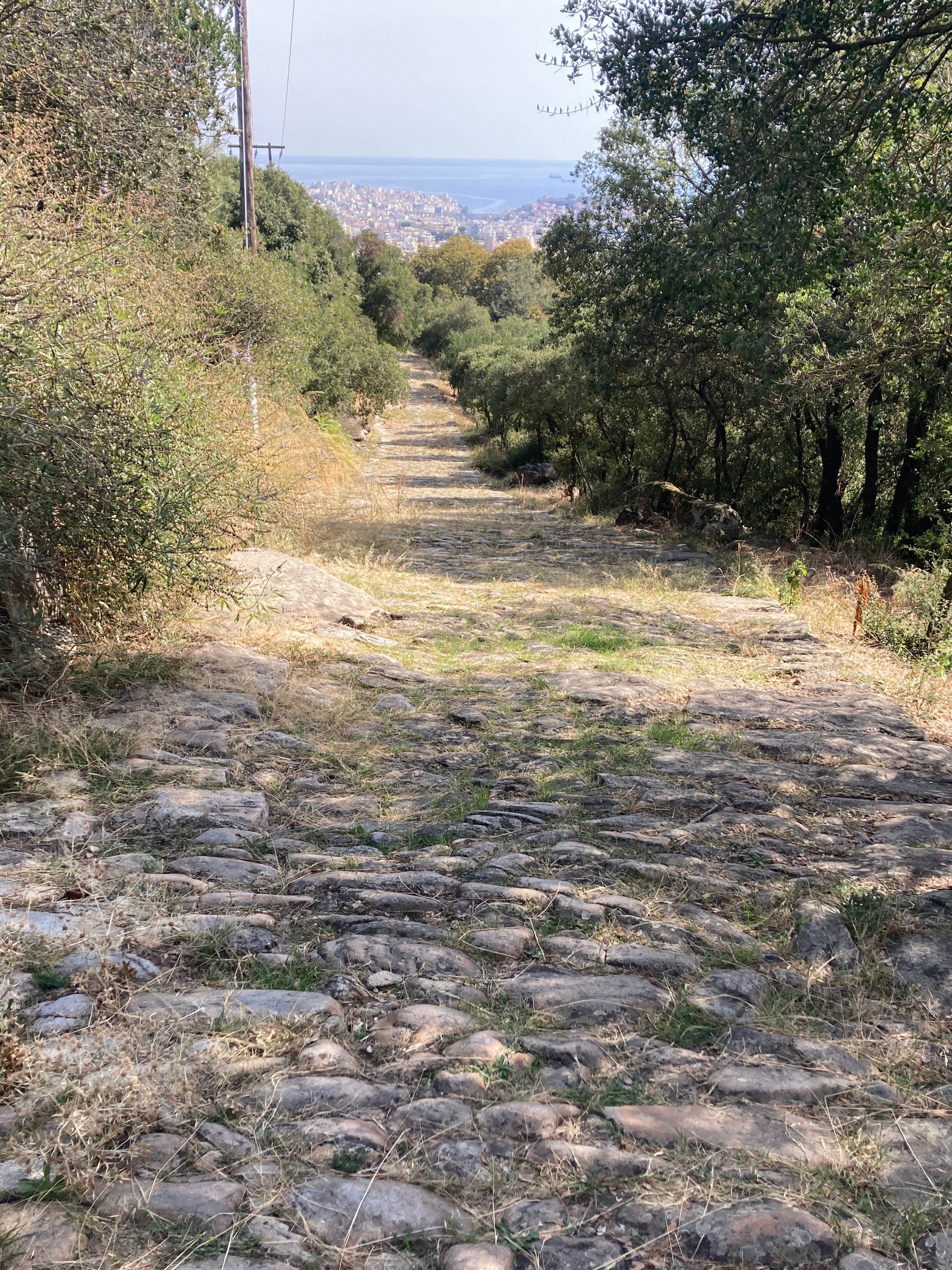
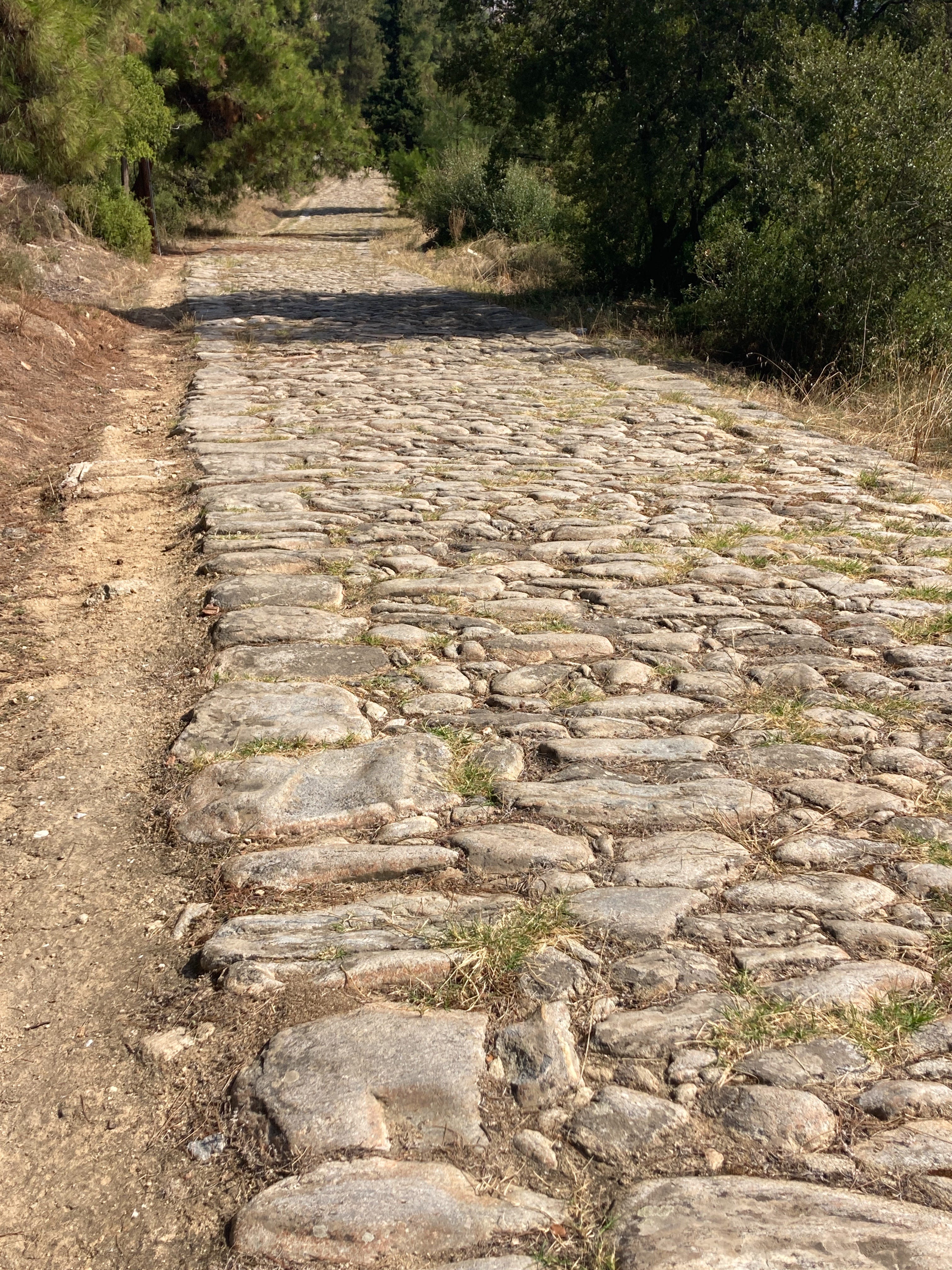
Not more than a couple hundred metres from my apartment the most unexpected, incredible human superstructure unfolds: the perfectly preserved remnants of the ancient superhighway Via Egnatia, constructed by the Roman Republic between 146 and 120 BC.
Yes, they already had superhighways back then.
The ancient road begins at the very edge of the modern town, suddenly emerging from the ground as concrete turns to dirt just where the last illegal settlements mark where the city unofficially ends, and where the forest begins. Obviously, the ancient road used to continue further in my direction and into the ancient Neapolis city centre, but one would have to demolish the modern city to uncover its exact route. I decide to follow what remains of the superhighway into the woods, and see where it takes me.
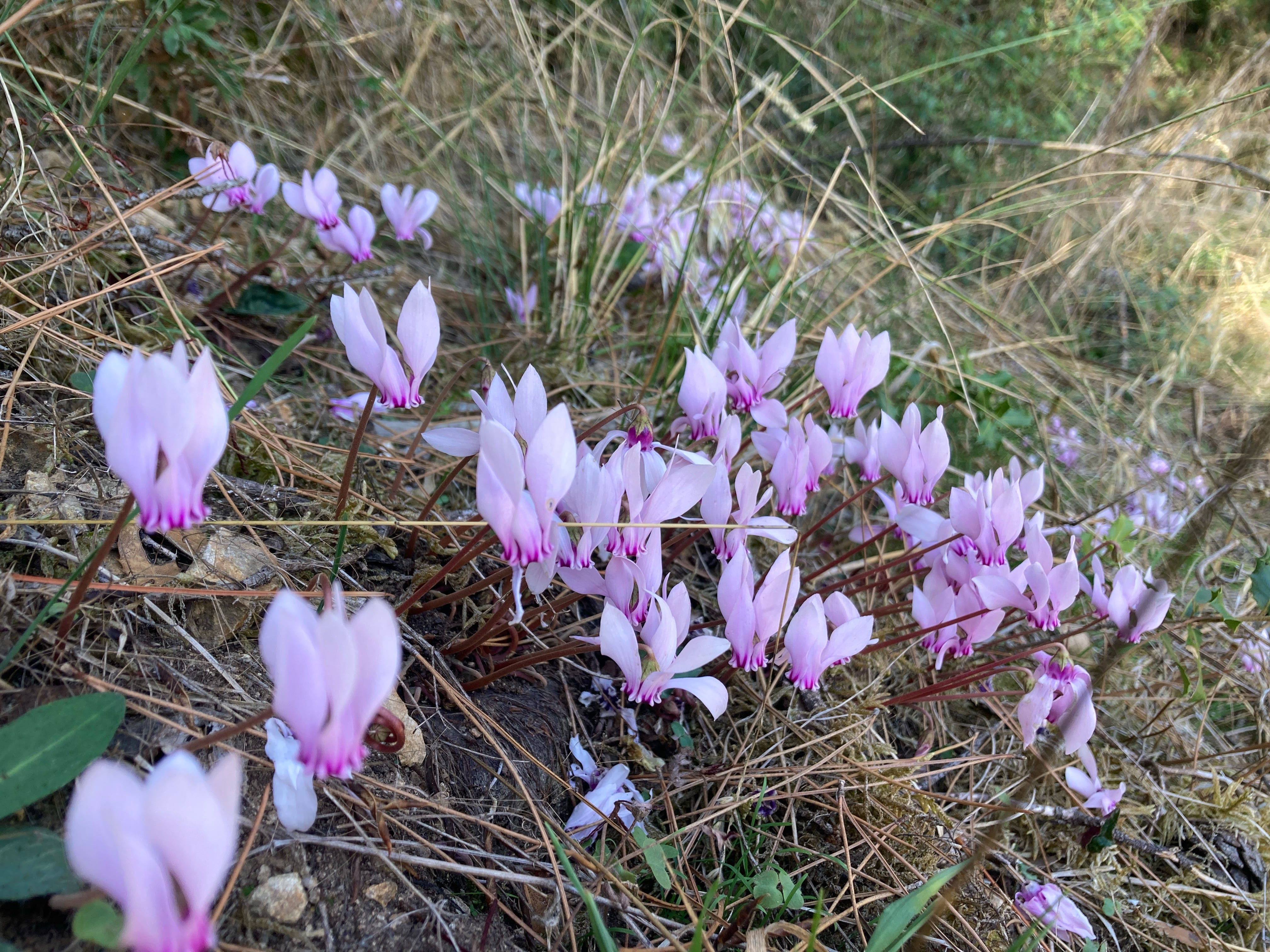
Flanked on either side by lush, mediterranean pine woodland and the occasional wild olive, the stone-made, wide ancient highway looks like something out of a time-traveller’s hallucination: I literally had to do a double take the first time I stumbled upon it during one of my foraging walks. I thought it was either a Byzantine, Medieval or much later, Ottoman construction, but this thing is actually 2,170 years old. The feeling of suddenly, seamlessly crossing from a modern neighbourhood right onto an ancient highway two thousand years in the past is a bizarre, other-worldly sensation. There is neither any signage nor any warning for unsuspecting tourists: you are about to enter a time warp. Bizarrely, the area is completely open to whoever, which is exactly why I initially thought I had hallucinated myself into a mirage. Am I the only one who can see this road? Is it real? I find it incredible how ignorant the city is of the ancient superhighway: it hasn’t even bothered to acknowledge it.
But it is not the lack of respect towards this historical monument that concerns me. It is the lack of respect towards time itself. The city’s silence around this monument is telling of how dismissive our societies are towards the past and its lessons. And although at face value it would seem that the modern city has consciously chosen to ignore the ancient superhighway’s existence, it is actually more of a case of civilisational amnesia: civilisations are always blind to both the past and the future. Cultures may look like they have evolved from each other, but they don’t. They simply obliterate each other, building new superhighways over previous ones and forgetting altogether that the past even happened. This is not merely a cognitive handicap. It is a divorce from consciousness which is as old as humanity itself.
The George Tsakraklides View is a reader-supported publication. To receive new posts and support my work, consider becoming a free or paid subscriber.
This ancient superhighway, what could easily have become the city’s number one hiking attraction, is the old blueprint of a formidable empire. Apostles Paul, Silas, Timothy, and Luke walked right over these same stones in 49–50 AD. Entire Roman legions led by Mark Antony and Octavian marched right through here, literally at the backyard of my house, in 42 BC on their way to battle. The Empire’s horseback courier mail, tradesmen of all sorts, locals and Christian revolutionaries, all used the superhighway. Suddenly, my sleepy hometown doesn’t feel so provincial. This was a hub, a brutal meeting point of armies, cultures, economies, philosophies and religions, as humans greedily fought over control of these lands. This was a melting pot where cultures and their highways were cast and recast out of stone, iron, and reinforced concrete.
And it still is. Not far from here, the first ever European Christian was baptized, allegedly. Her name was Lydia, and she decided to convert to Christianity after hearing one of St Paul’s sermons. The baptism site is located in a natural spring only 9 miles from here, and Via Egnatia actually goes directly to it. Bizarrely, hordes of big tourist groups from South Korea flock here every year to pay a visit to the various “holy sites” but also the plethora of Roman and ancient Greek ruins. After spending the lifetime carbon budget of their grandchildren on a single trans-planetary flight and soaking up the vibes of early Europe’s never-ending bloody history of religious conflict, they flock to the local supermarkets where they stuff their suitcases with the same two items: olive oil, and olive oil-made soap. Time to top-up that baggage allowance.
Like all cities, when my city was growing it completely forgot about its past: it had too many problems of its own to worry about, than concern itself with where it had come from, who was here before, and where it was heading to – ironically, these are the very same problems that this city had 2,000 years ago when this Roman superhighway was being built: civil wars, class struggles, economic uncertainties, and all the growing pains of an empire. My own family came here a hundred years ago escaping a genocide. They followed a modern superhighway just like this ancient one, to get here. They deliberately closed the door to the past, much like this city refuses to look into its rear-view mirror.
The way humanity always copes with the past is by deluding itself that it will never repeat. It builds new highways upon old ones, even though the destination is as uncertain as ever. Via Egnatia got in the way of this delusion, and paid the price.
As I ascend the winding, perfectly sculpted twists and turns of this ancient superhighway, my words are proven correct: not more than a mile into my trek and I run into a 25 ft-tall concrete wall. I look up and I can hear the high-speed traffic buzzing: it is the city’s ring road. The ancient superhighway literally disappears beneath thousands of tons of concrete. They didn’t even bother to build a fly-over.
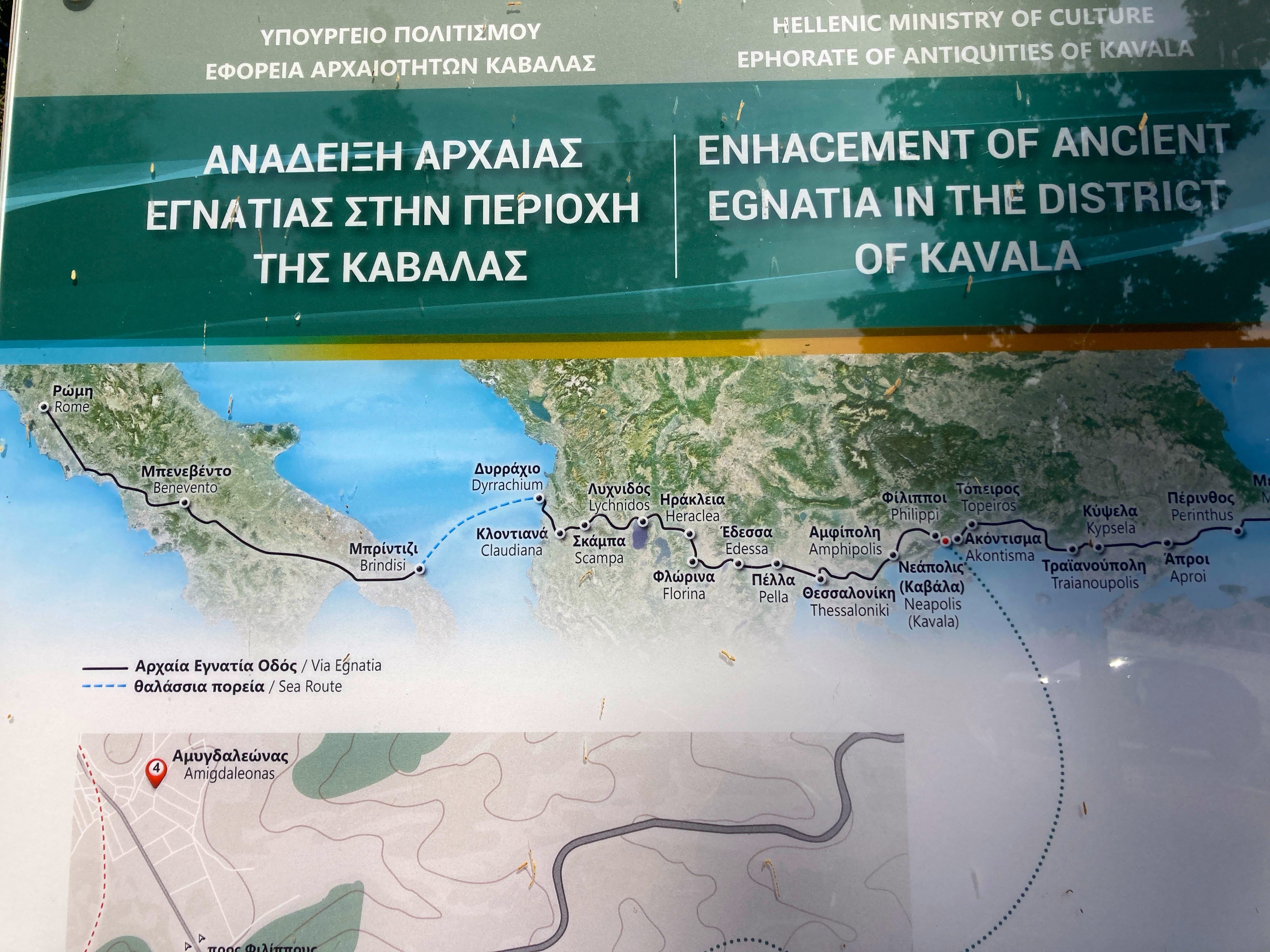
So, I decide to crawl myself up from the ancient time warp and cross the ring road in the hope of finding another stretch of Via Egnatia. Luckily, there is a pedestrian crossing. Ten minutes later, I come across a misspelled sign that finally acknowledges the existence of the Roman highway: “Hellenic Ministry of Culture: Enhancement of Ancient Egnatia In The District of Kavala”. It comes with a map tracing the superhighway across northern Greece, over the formidable Pindus mountain range and down into the Ionian Archipelago where ancient travellers could take a boat into Italy, and continue their journey on another stretch of the highway that eventually led straight to Rome. Alternatively, they could take the highway in the easterly direction all the way to Istanbul, then south to Egypt through Algeria, Tunisia, almost all the way around the Mediterranean and back to the capital. This ancient superhighway system covers more than 300,000 miles and extends as far north as Perth, Scotland.
But however many new highways a civilisation builds, it never has the slightest of clues as to where it may be heading. Drunk on high-octane fuel, the best it can do is delude itself that it is building new roads and exploring new places, when all it does is retrace its old routes: this time with thicker ink, making an ugly smudge on a planet which is a lot smaller than we thought it was. Humanity is increasingly looking like a really fucked up tattoo that you can’t really fix unless you get a skin transplant. All roads do lead back to Rome: because the Earth is round, it is finite, and it already has far too many Homo sapiens on it.
You may have noticed the paywalls on my newsletter.
They are not there to deprive you of insight, turn my readership into an exclusive club for the wealthy, or demonstrate how greedy I am.
They are there for a much simpler reason: the paywall is what pays my electric bill and allows me to continue writing, exposing, challenging the myths and mantras of this stupid necrosystem.
Those of you who have become paid subscribers deserve the exclusive access to my archive that you have. Without your support, there would be no newsletter at all.
Thank you so much!
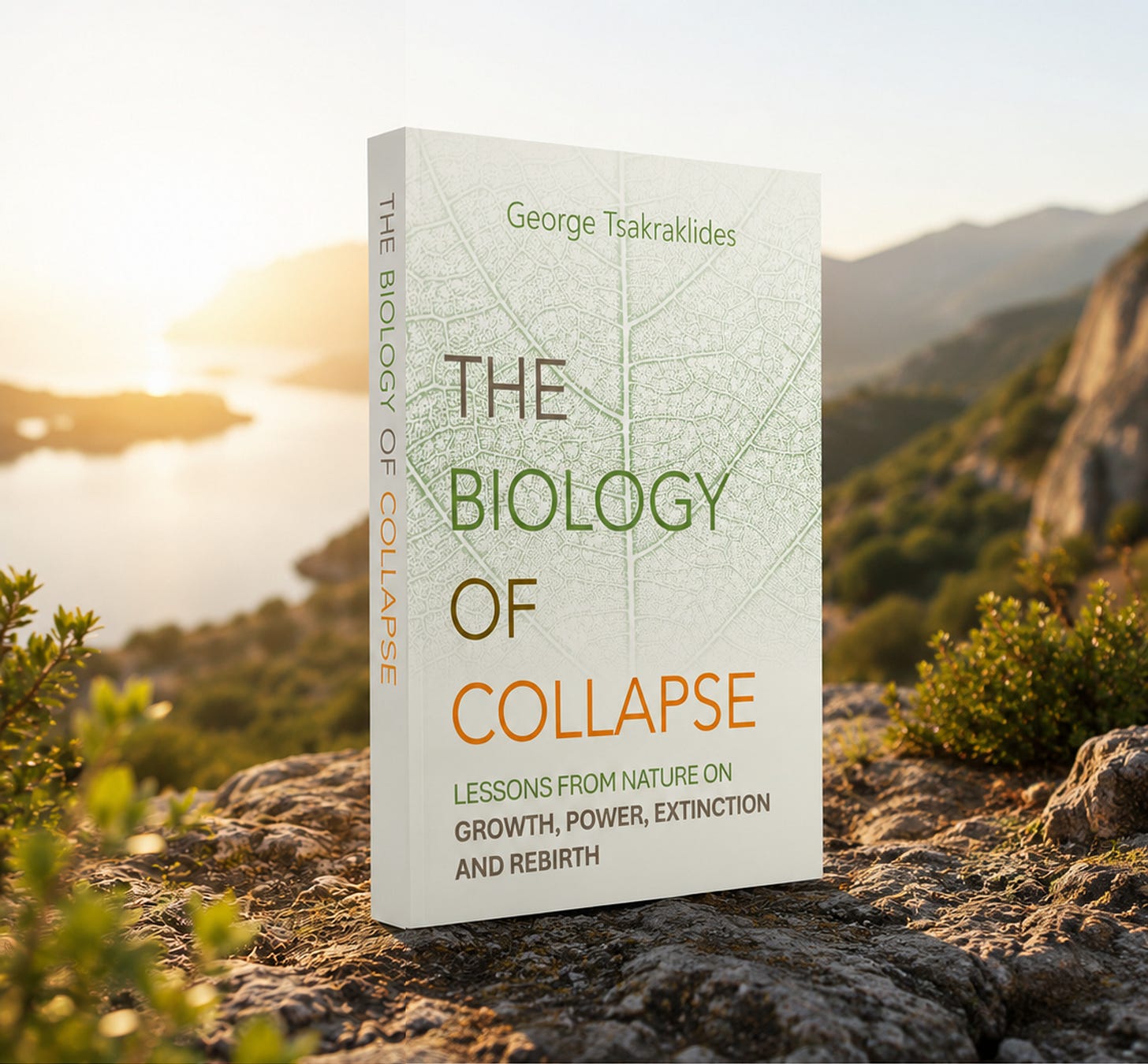
My new book, The Biology of Collapse is OUT NOW:
Discover more from George Tsakraklides
Subscribe to get the latest posts sent to your email.

