

When wolf packs become large, hunting success increases because large packs enable the specialisation of hunting skills, and allow for maximum collaboration. Birth rates go up as the abundance of food results in high fertility.
When human societies become large, resource exploitation efficiency increases because large societies enable the specialisation of skills and allow for unprecedented collaboration: humans put their minds together and innovate new technologies, create new industries, and acquire new territories. Birth rates explode as large scale natural devastation and the mass production of goods and services result in unprecedented fertility, and low mortality rates.
As wolve packs begin to overpopulate an area, a series of societal and physiological changes take place which are the direct result of the increased density of wolves per square mile. As the available hunting territory per wolf gets smaller, food becomes scarcer. Males stay with the pack well into adulthood as they cannot set up their own territory, and breed at a much later age, if at all.
As humans begin to overpopulate an area, a series of societal and physiological changes take place which are the direct result of the increased density of humans per square mile. The available farming territory per human gets smaller, and food becomes pricier. Intensive agriculture, fertilisers, herbicides, pesticides and big water diversion projects create an illusion of new abundance by increasing the productivity of the land, as ecosystems go extinct. Cities grow upwards as apartments are stacked on top of each other, and economic and religious myths are carefully crafted to convince society that there is plenty of resource around, for an infinite number of humans. Sustainable cultures and small-sized tribes are wiped out by capitalism, as everything is supersized, overproduced, and overconsumed. Population continues to climb.
As wolve populations reach their upper limit, reproductive success continues to decline as individuals become weak, contagious diseases begin to take their toll, and aggression between neighbouring packs fighting over resources becomes a daily occurrence.
As human populations continue to rise, reproductive success begins to decline as individuals become homeless, support systems fail, food becomes scarce, diseases begin to take their toll, the climate crisis makes much of the planet uninhabitable, and genocide between countries fighting over resources becomes a daily occurrence.
Both wolves and humans eventually come face to face with their own density threshold. Humanity has successfully delayed, for thousands of years, the negative effects of its own density. But physics always wins in the end. The longer the delay, the more spectacular the collapse will be. Even atoms have their own density threshold: you cannot pack more than a certain number of them within a given space. As with their own density, humans have tried to violate the density of atoms by colliding them, and found out the hard way what happens next: a chain reaction of nuclear fission, also known as a nuclear holocaust.
Density is a physical barrier that becomes more dangerous the more you push into it. Every sufficiently dense system eventually encounters constraints that cannot be negotiated away. We are about to find out what happens as we continue to toy with our own Density Threshold.
“Human civilisations are like shooting stars. They shine very bright, but then they disappear” – from my interview at the World Adaptation Forum
Thank you for reading. By joining other paid subscribers you can help this work continue. Thank you to all existing supporters, I couldn’t continue this without you.
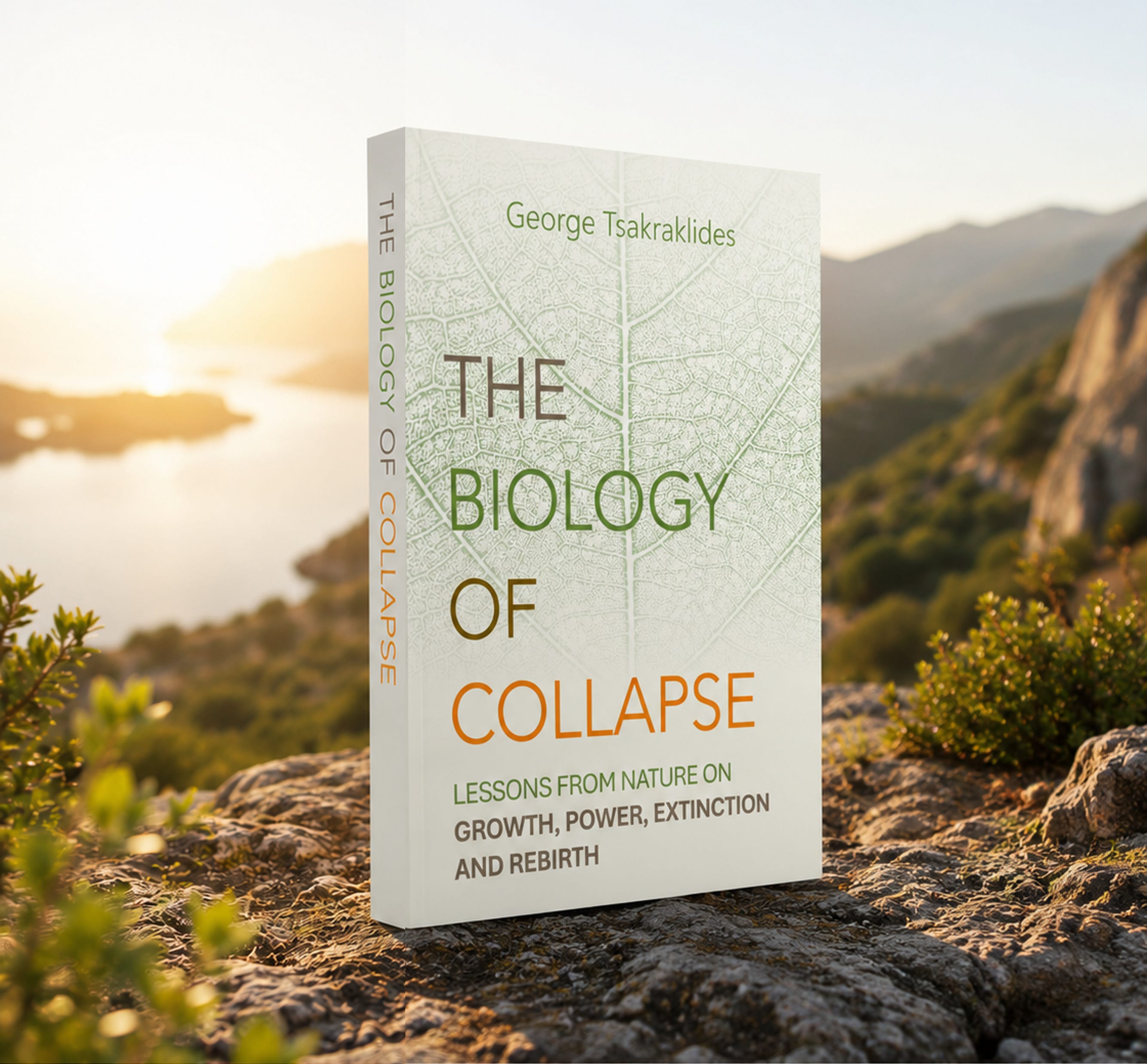
My new book, The Biology of Collapse is OUT NOW:
Discover more from George Tsakraklides
Subscribe to get the latest posts sent to your email.

