
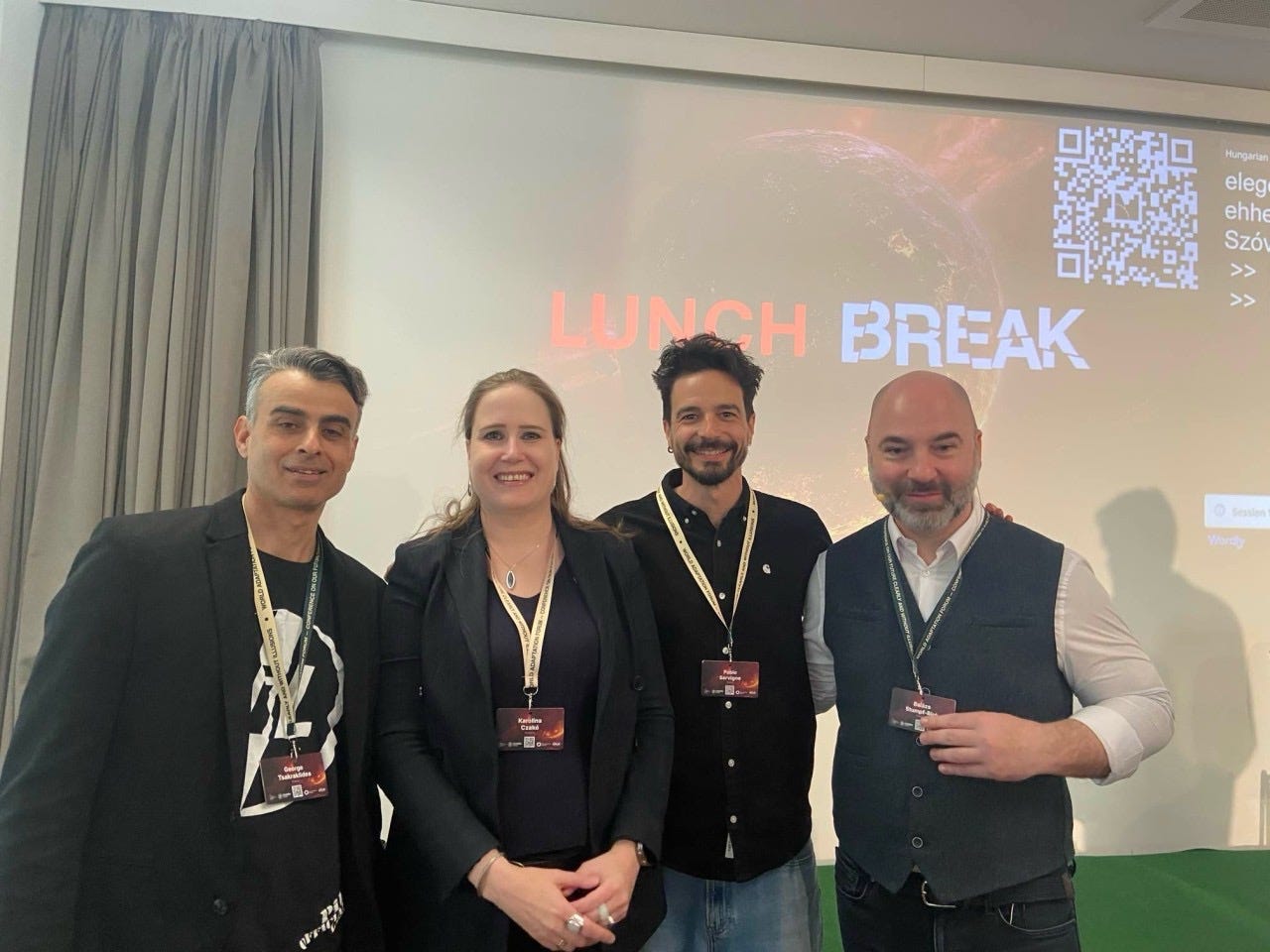
Just as the 2026 World Adaptation Forum in Budapest was coming to an end, silence was already beginning to rewild the space we had all desperately tried to fill with our voices, structured presentations, and conversations. Overloaded with three days of caffeine and overwhelmed by a cacophony of intellectual stimulants, I dedicated my last day in Budapest to explore the silence, only to discover that silence is not a vacuum: it is a busy, bustling creative space that works on its own mysterious pace and follows an entirely different set of physical laws. Silence is where the pieces of our echoes finally begin to fall into place, reorganise, and form new galaxies and solar systems of consciousness. The organisers of the conference called this “The Afterglow”.
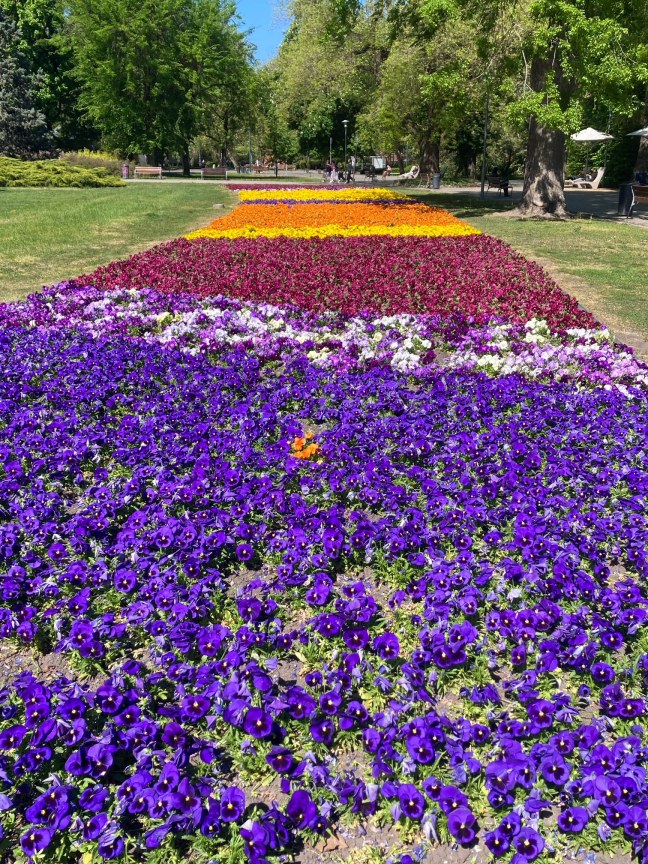
There was no better place to see the afterglow than at Margaret Island, a nature reserve set on an island right in the middle of the Danube. There, the most vivid demonstration of the power of silence awaited me in one of the flower beds. In amongst armies of pansies autocratically planted in strict rectangular battalions arranged by colour, there was a defiant rebel: an orange pansy blooming in a sea of blue pansies, bravely defying all orders from above.
But this anarchist was not a product of conscious intention, but of the creative chaos that silence invites when we stop forcing things into categories, colour blocks and “frameworks”. When we let the debris of our thoughts fall into place naturally, the result makes much more sense than any order, hierarchy or pansy colour silo.
I kept staring at the rebel pansy for a few minutes, trying to take a guess where the “mistake” could have happened: an orange seed had been mixed in with the blue pansy seed stock back in the nursery. Maybe an orange plant had accidentally been mixed in with the blue plants during transport, planted in the ground as a seedling before the plants had produced blooms, therefore evading inspection. Or, one of the gardeners decided to play a practical joke. It doesn’t matter. What matters is that silence, and the chaos it invites, always have their way in the end, however much we try to control and organise them. Entropy always wins over intention.
This message matters, because much of what humans do involves artificial hierarchies and categories we construct to make sense of a world that is only meant to make sense through the incredible power of chaos. Order is futile because it always leads back to disorder. Disorder will always find a way to creep back in, whether this means disrupting a siloed pansy flower bed or a siloed way of thinking.
My breakfast conversation with Zsolt, who along with Balazs is one of the two masterminds behind this one-of-a-kind yearly event, confirmed why humans have ultimately failed to make themselves a sustainable part of Earth: our actions, and our thoughts, are plagued by the tyranny of order: hierarchies, labels, frameworks and silos, whether they are racism, speciesism or climate denial. We live only in our heads, out of touch with the chaos that is trying to communicate with us. The orange pansy is trying to make a point, but if my guess is correct, it has probably already been dug out, thrown in the compost and replaced by a “compliant” blue one.
It is not chaos we should fear, but the iron curtains separating the multiple versions of reality we manufacture, never allowing them to mix. Chaos is not a disruptor but a repairer, finding the paths of least resistance which bring balance back into a sea of conflicting orders. Chaos always results in stability, while forced order doesn’t. Trying to control the chaos will only provoke it. Unless we find ways of emulating natural chaos in how we run our civilisations, chaos itself will do it for us through the collapse of our silos, frameworks and crystal castles of false hierarchies.
Like an over-manicured garden that has become a monoculture of thoughts, order will always be fragile at best. A chaos of weeds however is incredibly resilient. The ecosystem, and any system, always needs states of chaos in order to make sense of reality: even quantum particles such as electrons get too bored staying in their own orbits. They wiggle, change spin, jump lane and even jump over to other atoms before they settle. Others yet, turn into pure, chaotic energy.
This is not about learning to make allowances for chaos and imperfection, but about learning that chaos is the actual creator: what has always been there, and what gave birth to us since the beginning. We need to invite the chaos back in. Those who want to control, oppress, and destroy are not direct agents of chaos but selfish provocateurs. The destructive chaos that ensues from their actions is nothing other than the universe reorganising itself against enforced orders. Whenever there is too much order, the system perceives it as an imbalance: of power, money, or energy. It invites the chaos back in so that it can restore the system to a more stable configuration: an unequal society and a planet succumbing to a lethal energy imbalance are both examples of systems no less unstable than a uranium atom succumbing to its own radioactive decay.
We need to trust in the chaos, and to create moments of silence where the chaos can weave its healing work. Each time we get lost, siloed or trapped, it is always the creative chaos, not the order in our head, that will point us to the light at the end of the tunnel. And each time the system tries to separate, sort us and divide us like blue and orange pansies in a flower bed, it is always the chaos that will bring us back together.
This is a reader-supported publication. To receive new posts and support my work, consider becoming a free or paid subscriber. THANK YOU to those supporting me already and turning this into a vital source of living for me. I appreciate you so much.

Discover more from George Tsakraklides
Subscribe to get the latest posts sent to your email.

