

I’m the type of person who hates goodbyes so much so that, I simply don’t do them. That awkward moment when you have to look into someone’s eyes and say the stupid word, acknowledging that both of you have been defeated by time, fate, circumstance, and whatever else is coming between the two of you at that moment, forcing the goodbye, has always been incredibly uncomfortable for me. I never managed to manage that moment.
So, I don’t linger in it. When I say goodbye, my feet immediately start walking. People sometimes find this abrupt. I find it honest. Or perhaps that’s simply the story I tell myself to avoid the uncomfortable vulnerability of goodbyes. I’d rather be an emotional Nazi. My military approach to saying goodbye is probably the signature behaviour of someone with deep anxious attachment issues: the strings have to be either completely on, or completely off. The untangling must happen quickly and abruptly in order to reach emotional equilibrium. Otherwise, you or them may start speculating: “who wants to say goodbye the most?” If you start lingering, delaying the goodbye, they might get annoyed, or you may come off as desperate and clingy. In some cultures, creepy.
Unlucky for me, I come from a culture where people are never meant to actually “mean” their goodbyes. They spend forever saying goodbye – not because they enjoy emotional torture, as I used to think, but because they want to defeat the whole concept of “goodbye”: they beat it to death, literally, until you are never sure you ever said goodbye, even after you parted. In Greece, you have to allow at least an hour to say goodbye to someone, and you can never be sure you actually did say goodbye. Goodbye is a long, arduous process that involves almost as much preparation and choreography as the initial courting. There are two distinct stages:
First, the idea of “goodbye” has to be floated. This must be presented as a random suggestion, not an ultimatum. It is to be discussed and deliberated, until a consensus arises and a mutual acknowledgement takes place: we have to say goodbye, eventually, at some point in the evening. This excruciatingly slow movement towards “unhooking” can take surprisingly long, especially when there is resistance at either end. Average time: from 15 minutes to as much as two hours, especially after multiple failed attempts.
Stage two: The drifting of the conversation to all the “goodbye” topics, all those miscellaneous items we forgot to catch up on earlier. Rather than a goodbye countdown sequence, this just gives the whole social event a second wind. “Are you working tomorrow?” What are your plans for the rest of the summer?” The possibilities here are endless. Greeks turn goodbyes into an event all on its own. They flip it from a moment of detachment to one of re-attachment. When I was a kid and my parents had people over, I always hated the 15 minutes at the door as they said goodbye to guests. Everyone is up, coats back on, no one is leaving. Finally, the door opens. Another 15 minutes with the host holding the door ajar, as guests are literally out in the hallway. Anything and everything to prolong this stage will come up, as an excuse to prolong it. “And when is your oldest starting college? Is it this fall?”. Average time: 30 minutes, with a bonus 5-minute farewell from the balcony. Optional Stage three: “Which way are you going? Let me walk you to your car”. Fucks sake.
But probably even more excruciating is a planet slowly saying goodbye to you. This one is permanent. All of us are experiencing a parting that will last until the end of our lives, as each year we say goodbye forever to a planet that ages, burns and is erased in front of our eyes. For some of us, the slow speed of the goodbye is reassuring. For others, it is a form of lifelong torture. Every year that gets hotter we are saying goodbye yet again to the coolest summer of the rest of our lives. Every time El Nino brings about mass extinctions, another list of marine species must be crossed out from the biology textbooks of our children.
The world as we know it is disappearing. The long, slow goodbye to the stable climate and ecosystem we enjoyed for tens of thousands of years is not a casual parting with a friend: it is a chain of back-to-back funeral processions accelerating in front of our eyes until they become a photographic smudge on film. The coffins are filled with everything we had taken for granted: our lifestyle. Our food. Peace. Health. A habitable planet. This goodbye is non-consensual and utterly uncivilised. It is a nasty, brutal divorce. Humans are being banished from paradise for a second and final time, as the planet enters the long process of healing from the infection.
This is a reader-supported publication. To receive new posts and support my work, consider becoming a free or paid subscriber.
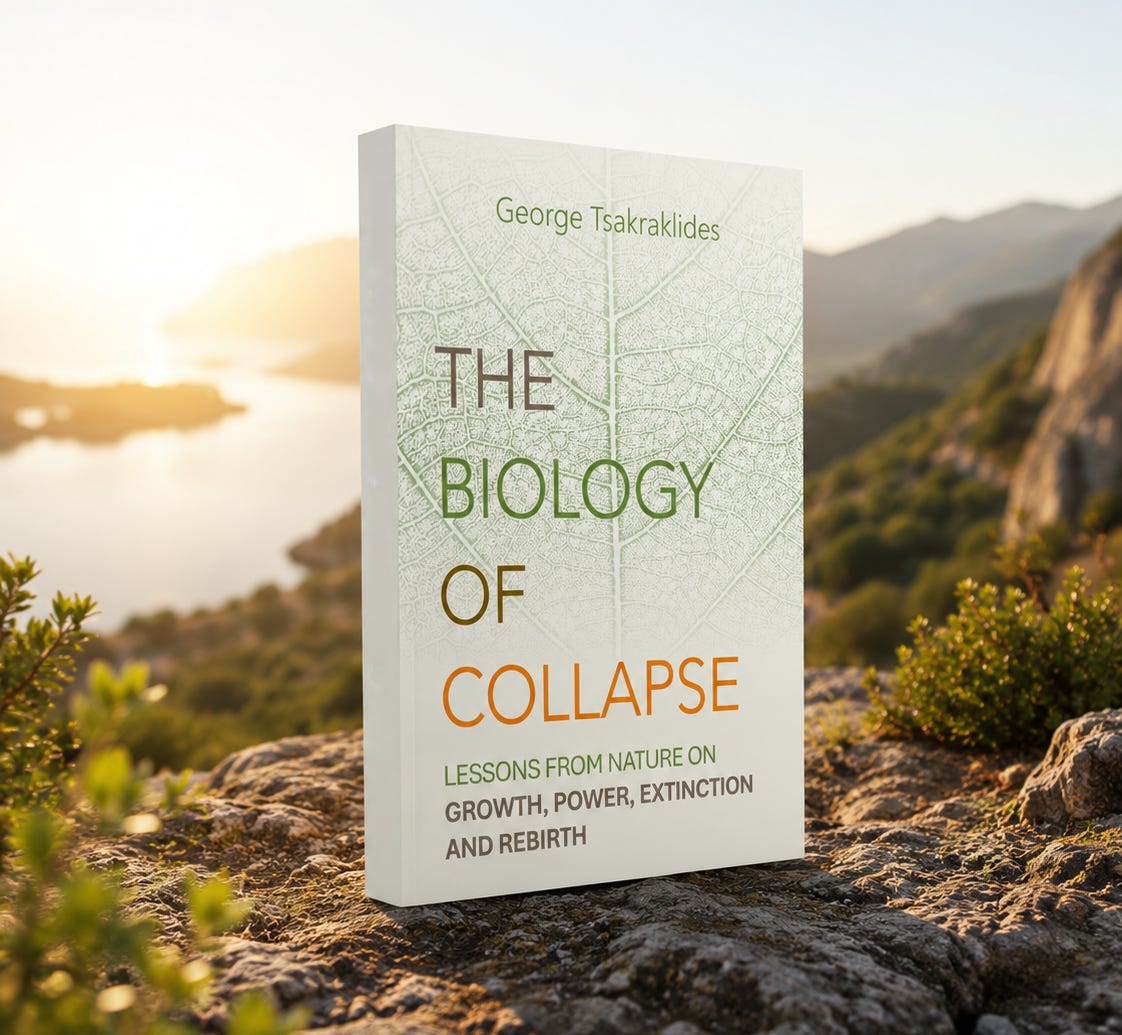
My new book Out Now
Discover more from George Tsakraklides
Subscribe to get the latest posts sent to your email.

