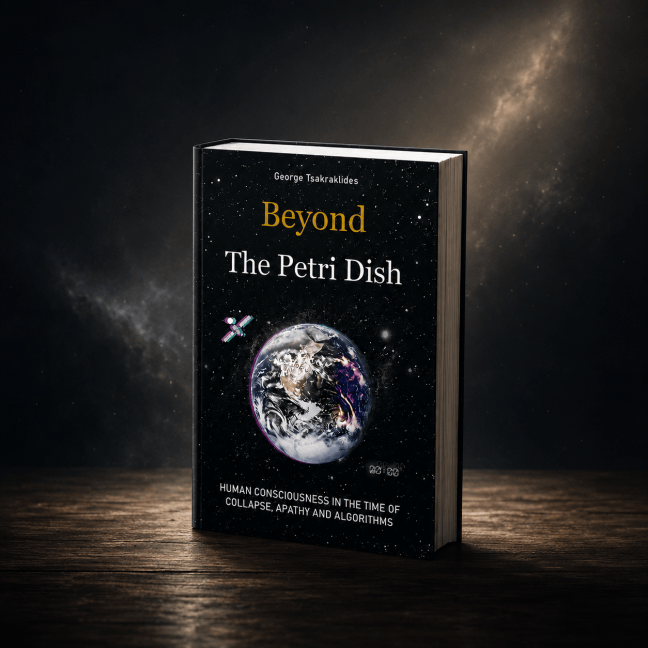
I’ve been re-reading and revisiting my book Beyond The Petri Dish, published more than two years ago. What was a collection of essays that was treated by some as science fiction conspiracy “poetry”, is now sadly coming true. If you had asked me back then, I would probably have given this a 10-year timeline to materialize. But now it’s here already.
So today, as our e-mails, refrigerators and airports fall silent, I re-introduce you to the concept of The Great Silence, bringing you an entire essay straight out of the book. Back when I wrote this, I talked about the Great Silence in mostly metaphorical terms. But it looks like it is now increasingly infecting the tangible world.
Filler Humans and The Great Silence
“Today I ask the question: what is the role of humans then, on a planet overtaken by self-aware versions of profit? The answer is in the silence. We have entered the age of The Great Silence: the time right before a society collapses and when consciousness and critical thinking take the back seat to resignation. This civilisation has muted itself right at the point in its history when it should be screaming its lungs out. Activism against the necroeconomy is increasingly marginalised and coming up against organised, well-oiled AI-mediated PR machines and anti-protest laws that use the full capabilities of The Thing to quash nature’s rights and human rights. Profit controls information and entertainment, ensuring everyone stays amused as this planet falls apart one tree, one climate system, one nation at a time. This is not a civilisation but a gargantuan gaslighting exercise: what we consider an incredibly vibrant, busy and restless world, is actually a façade for the most asleep society we have ever experienced.
In a world where synthetic has become genuine and consciousness is interrupted by curated shopwindows, humans are now real only in the physical sense: we live in a zombie world held together by brands, illusions and addictions that guide us from one level to the next like video game heroes eager to be told where to go, what to buy, and what to believe.
Humanity is not only helpless, but hopeless: despite unprecedented technological power, a record number of democracies, and record number of smartphones on the planet, we have completely lost control of the situation on Earth – and some of us know it. While many of us may think that we are in charge of the direction of this civilisation, and that we take our own decisions, we don’t really. No one is in charge: no one is in charge of this automated train to hell, except perhaps, the fossil fuel in its combustion chamber.
Everywhere you look there are humans made of real flesh and blood – but make no mistake: they are merely the filler material of this system: holographic versions of former humans who now execute the profit dogma. We live under the delusion that society is kept together by humans, when everything is actually directed by The Thing: the corporations, profit algorithms and media machines servicing a self-aware necroeconomy. Humans are merely the red blood cells in this beast: their path is predetermined, and their whereabouts known at all times. They are components of a biomechanical economic life form designed to eat itself, down to the very last, dried-up remnants of its carcass.
For a species that invented the concept of personal ownership, it is ironic that it would ultimately become owned by the very objects it acquired. Having been reduced to filler material within a necrocapitalist matrix, humans are locked into a consumatronic slavery situation: their owner has no face, but they own, manage, and occupy every single niche of this dystopia.
The invention, legislation and deification of personal ownership was the door necrocapitalism used to step in and own us, in every possible way. As surveillance, automation and supermarketization of all physical and data real estate engulfs everything, humans are becoming commodities in the shelves of the consumaverse. As we merge with the products we purchase, we become virtually indistinguishable from them to the point where it is no longer clear whether it is the human buying the product, or the product buying the human. Much like the arguments proposing that dogs domesticated humans, it can be argued that products domesticated consumers: we may think we’re the ones making purchasing decisions, but it is in fact the products who are buying us, choosing us, changing our lifestyle, our decisions, our opinions.
We became the favourite pets of the fashion industrial complex, gaming consoles and the marketing industry of the Unhappiness Machine. This domestication gathers pace as we commodify ourselves: human self-worth has been replaced with a frantic quest for likes, follows, and frivolous endorsements as we compete in the dopamine marketplace. The value that humans place on other humans is now commodified, quantified, monetized and weaponized. In an economic system where everything is ruthlessly put up for sale to reap the fastest return, it is easy for both buyers and sellers to forget that they themselves are part of this financial meat market: they have become consumables, in every sense of the word.
By devolving into commodities, humans are undergoing a grotesque transformation: becoming the silent partner in a symbiotic relationship with sentient necrocapitalism. As their sensory system and intellect degenerate into atrophy, it is only a matter of time before the dominant, and more intelligent member of this partnership, completely discards them.
The fast-moving consumatronic dystopia has no use for humans who hesitate, think, and take too long to make a purchasing or voting decision. Impulsive reactions are encouraged through prefabricated options, autosuggestions, and synthetic reality: “just trust in the system”.
Yet despite becoming commodities, we feel more liberated than ever. This cognitive dissonance is the result of the entertainment sedatives of The Thing. Human freedom is no longer measured in intellectual independence, but in how many brands of chemically processed bread we have access to at the supermarket. Modern humans are the most emancipated slaves to have ever existed.
The legal status of a human being is beginning to resemble that of a product: large parts of us have already been migrated to the unregulated marketplace of the AI cloud where they are registered, weighed, hash-tagged and fed into agentic brains for further processing. As each piece of our identity becomes an individual product, the human being becomes a mutilated consumable.
But products only have value for as long as they remain on the shelf. During this time, they will need to stay silent, smile to the shopping trolleys zooming past, and never give off any signals that something about them may be “different”. Soup cans need to look exactly like all the other soup cans or shampoo bottles. To remain desirable, they need to relinquish any rights, opinions or objections they may have had before they were abducted, canned and placed on the shelf. Any deviation in shape, size or colour is serious grounds for termination, given that this product, or human, will be a “hard sell”.
If such a fault is discovered, the item must be marked as waste and destroyed. Those products that escape the waste bin are only marginally more fortunate: they are given a sell-by date that expires as soon as they become unmarketable. This is the date when they too, become a waste of space. In this economic architecture if something is not sellable, or doesn’t receive any monetizable “airtime”, then it is absolutely useless. Even our birth and death are commodities. What happens in between is one, big, consumatronic transaction.
This civilisation can only become sustainable through the death of the fast-moving product: as long as everything on this planet is seen as a personal consumable, as opposed to a shared resource, it will always command a price tag, a sell-by date, a carbon footprint, landfill space, a social disaster, and an untimely death sentence. As long as the Unhappiness Machine is woven deep into our social fabric, this civilisation is destined to spin, spiral, crash and dismantle itself in one, big, spectacular collapse.
The vast majority of humans today consider capitalism inevitable. This undoubtedly means that they consider natural destruction, the climate crisis, colonialism, exploitation, inequality and genocide inevitable. This is the most defeatist and idiotic surrender to existential demise. Future humans who may survive this catastrophe will wonder why, and how on Earth, we managed to stay so distracted by our screens, jobs, and mutual genocides, just as the planet was becoming uninhabitable. The new society we are being offered is nothing but a collection of commodified, single-use life forms and “filler” humans fighting for what’s left. The world we are entering is not only anti-human, but anti-life. Every life form will be pushed to its limits of existence.
Yet despite being reduced to commodities, we have learned to accept, and expect, our own exploitation by the necroeconomy. This is because, so far, the rewards of our obedience were enough to convince us that this frenetic world is worth the stress, sacrifice, and loss of personal freedom – and that alternatives do not exist. But now that the rewards are vanishing, it is time to revolt against the system before it has both us and the planet, on our knees. As profits vanish, the necrosystem will try to confiscate every remaining scrap of resource, then charge us double for it.
Self-destruction is in the DNA of this economic machine, and filler humans are already on the chopping block by an algorithmocracy that will soon have no use for them. We need to get off this vehicle before it jumps off the cliff, and we can only do this by breaking The Great Silence: opening our eyes to the only viable way of existence on Earth: where nothing is owned, and everything is sovereign”
You may have noticed the paywalls on my newsletter.
They are not there to deprive you of insight, turn my readership into an exclusive club for the wealthy, or demonstrate how greedy I am.
They are there for a much simpler reason: the paywall is what pays my electric bill and allows me to continue writing.
Those of you who have become paid subscribers deserve the exclusive access to my archive that you have. Without your support, there would be no newsletter at all.
Thank you.
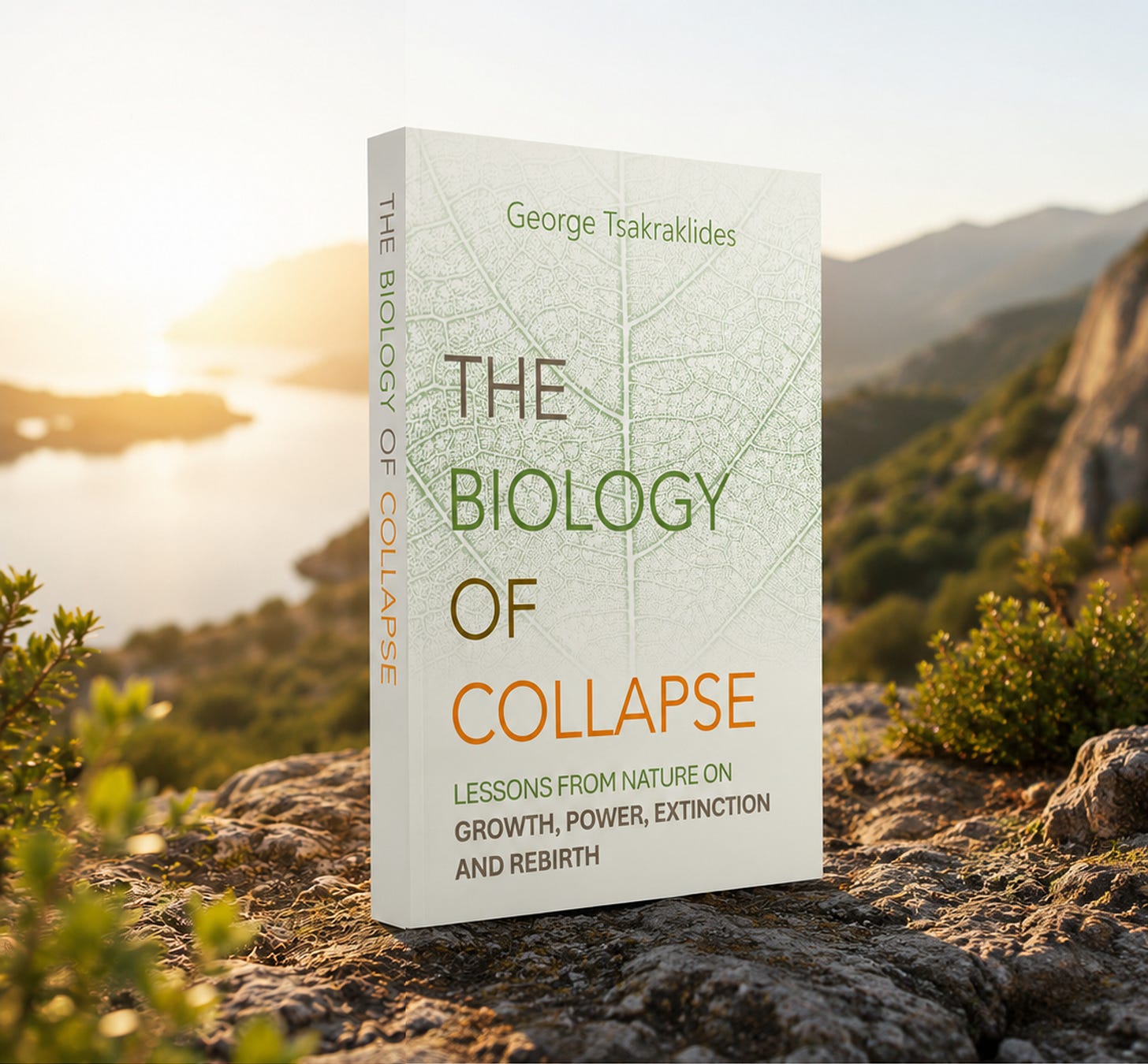
My new book, The Biology of Collapse is OUT NOW:
Discover more from George Tsakraklides
Subscribe to get the latest posts sent to your email.


They’ll be sorry. Oh well!