
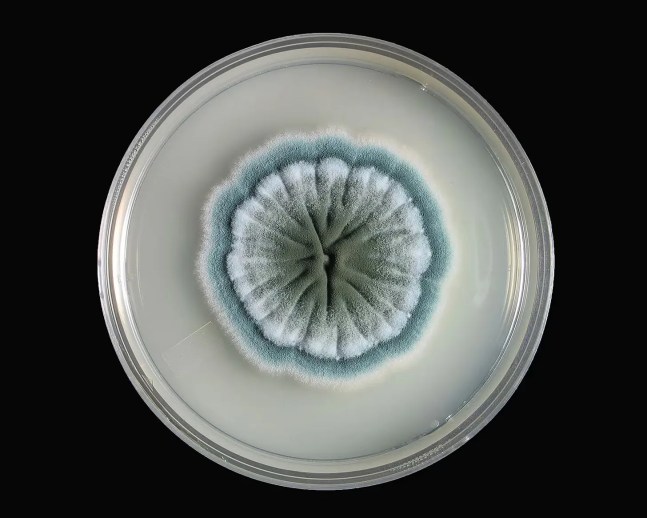
My first job out of graduate school was also my first and only job offer. I jumped at the opportunity of becoming a manager at a fungal microbiology laboratory, specializing on indoor mold: people would bring me samples from their blackened shower wall, their carpet, or their basement, and I would analyze them. I would grow the mold in my laboratory and identify which specific species of fungus they had in their house, and whether it was lethal or not. The job of a mycologist may sound geeky and uninteresting, but we get to witness the rise and fall of civilisations within a matter of days: each fungal culture in a petri dish is a micrography of humanity.
Phase One: Growth and Gluttony
The civilisation starts with a single individual inoculated onto a food source. In the beginning there is so much food available to the fungus that it seems infinite. The microorganism begins to multiply rapidly, dividing every few hours: 2, 4, 8, 16, 32. The exponential growth phase is the most surreal and deceptive in a civilisation: there is so much momentum, so much optimism and so much abundance that, there isn’t the slightest shred of evidence that this is all about to slow down. Exponential growth at breakneck speed is the defining quality of early-stage capitalism: population spills out into the country like a virus, luxury becomes the norm, and innovations turn obsolete before they even enter the market. Humans already experienced this exponential phase during the industrial revolution.
Phase Two: Size and Specialization
As the fungal colony begins to approach the edges of the petri dish, growth has already slowed down significantly. The availability of food is not what it used to be, and competition is rife. But what the fungal colony has lost in momentum, it has gained in size and experience. It is now a formidable, massive civilisation of billions of cells. Population size is the defining quality at this stage, and it is not unusual to see mutations emerge, leading to specialisation of individuals and the formation of complex societies: fungal cells with unique adaptations help the colony continue by creating new capabilities: some of these cells make new, harsh chemicals that can break down some of the nutrients the colony wasn’t able to previously utilize. Some of them become efficient transporters of digested food throughout the colony, helping in communication and coordination. Others develop defensive and offensive capabilities that can annihilate other fungal colonies growing on the same petri dish. As the civilisation grows, these mutants become increasingly important and eventually take control of the colony. Despite having all but exhausted their resources, civilisations continue to grow by transforming themselves into efficient, exploitative societies. This is the threshold where the civilisation crosses into late-stage capitalism.
Phase Three: Decline and Cannibalism
As the colony reaches the edge of the petri dish, it literally slams into a wall. The food is all used up. The air inside the petri dish is unsafe. There are by-products of fungal metabolism everywhere, including the very chemical warfare the fungus itself had produced. The petri dish becomes a toxic trap, but not all fungal cells are made the same. As civilisations run into resource depletion, the most innovative individuals now become the parasites: no longer able to monetize an ailing economic system, they invent a new business: genocide. The colony begins eating itself, including its children. The proliferation of evil is the most telling sign of a late-stage civilisation: the volume and frequency of evil at this stage becomes so high that it becomes normality. This marks the end of society, and the end of the civilisation.
My job at the mycology lab lasted only 6 months. It turns out that the business I was in was just a temporary fad, quickly shut down by the recession following the bursting of the dot com bubble. I was made redundant, as the fungal colony sacrificed me to conserve its resources. At the end of the day, I was only a single cell in a population of 8 billion, living my last days on the petri dish.
This is a reader-supported publication and my main source of income. By becoming a paid subscriber you can join other readers supporting my work and ensuring this newsletter can continue. Thank you so much for all your support.
Discover more from George Tsakraklides
Subscribe to get the latest posts sent to your email.
 George Tsakraklides
Thank you! Wonderful summary of population dynamics and great extended analogy. As I wrote here: https://www.whp-journals.co.uk/JPS/article/view/653/486 Earth is to H. sapiens as Petri dish is to Bacillus sp.