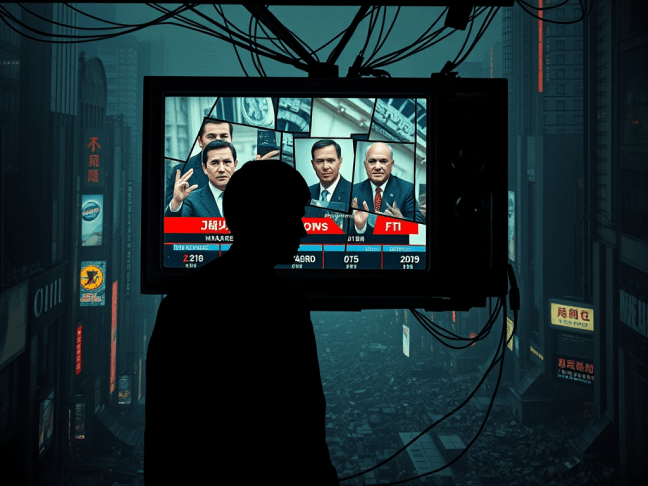
The worst enemy of truth is half-truth. Decades of distraction and confusion through hyper-narcissistic consumatronic programming have made us so overloaded that we only pay attention to headlines, not the facts behind them. We have become much less curious and increasingly apathetic about what is happening around us. As our access to truth becomes monopolised by a dystopian media complex that casually merges news with entertainment, our relationship with reality is already highly dysfunctional.
While activists continue to raise the lack of fair and honest news coverage of humanity’s real issues, more coverage won’t help. It will result in more desensitisation, hypernormalisation, sleep, conditioning and complacency as this media complex creates and defends its own version of truth. As long as the media remains a propaganda outlet for necrocapitalism, the mind prison will only get stronger, not weaker the more imagery and information it is exposed to. Facts have become nothing but the raw material for assembling new versions of the truth. As this dystopian news and entertainment complex absorbs all this input, it integrates it into its own narrative: a story that is made up of real facts which have been redacted and rearranged to present an entirely new “truth”.
We may have installed eyes, ears, cameras and satellites all over Earth’s surface, but we remain utterly blind to the greed that is choking life to extinction. Truth is now synthetic, happiness is manufactured, work is meaningless, and everything is bought and sold by the most absurd concept: money. Meanwhile, there is an important message: “We interrupt our colourful coverage of the Global Collapse for a very brief Chipotle commercial”.
George is an author, researcher, molecular biologist and food scientist.
Follow me on tsakraklides.bsky.social
Discover my Books Here
Note to my readers: I keep my site FREE because it’s not right to paywall existentially important content during an existential crisis. But if you appreciate any of the work I’ve done over the years, please consider joining as a paid subscriber so it can continue! I have minimal overheads, no sponsors to sell myself to, bosses who tell me what to write, or staff I have to pay. It’s just me. This freedom does mean though that your support is vital. Thank you so much.
Discover more from George Tsakraklides
Subscribe to get the latest posts sent to your email.
 George Tsakraklides
I’ve never liked the flattening “We” that reduces all the complexity of humanity to a single entity.
You, for example, do not seem to be greed-addicted like the majority of the species. My humanistic ideas are not widely shared, to use another example.
“They” is a better term, unless the action or thought self-applies. Too much finger-pointing where it doesn’t belong gets into scold/scourge/crank territory.