
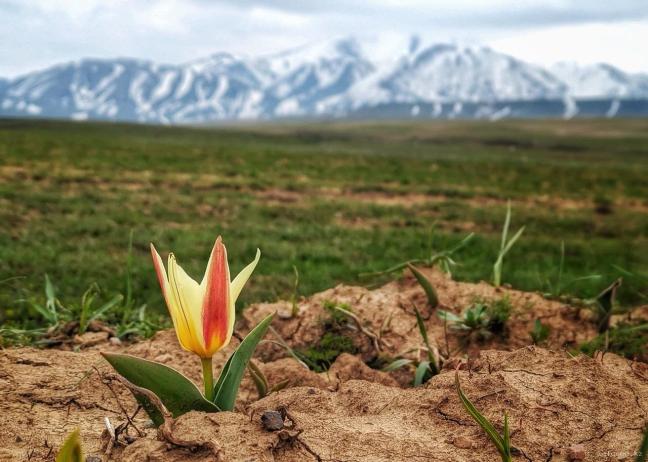
125 million years ago an exceptionally long, baking hot summer began to sweep through the Celestial Mountain in the Tien Shan alpine range spanning modern-day Kyrgyzstan, Kazakhstan, Uzbekistan, Tajikistan and China. The scorching conditions on the desiccated slopes of the mountain left little room for survival for the great majority of organisms, and the freezing winters that followed were no less brutal: subzero temperatures and thick snow brought life to a virtual standstill for a good part of the year, and a great number of organisms, especially plants, were driven to extinction. The slopes of these mountains were no place for ordinary life. This was one of the most inhospitable, uninhabitable places on Earth. The summer here didn’t end in August. It carried on into autumn, only to be abruptly interrupted by plunging temperatures and blistering cold winds that signalled the beginning of long, freezing winters. The only conditions hospitable to life appeared during a brief period in the spring, before it became too hot again. This mountain was a death trap, a place where natural selection revealed its ugly face and showed little mercy.
This is a reader-supported publication. To receive new posts and support my work, consider becoming a free or paid subscriber.
Those plants that tried to survive by growing were the first to perish: photosynthesis in the high summer heat and alpine UV radiation was the quickest, surest way for any plant to die, quickly depleting its water and nutrient stores. Equally, producing fresh shoots in the middle of winter was nothing less than suicide. And yet, in what seemed to be the end of all plant life on the mountain, there were some unlikely survivors.
But these survivors were a most curious, unorthodox bunch. Some may say they were perverts, deviants and losers, because contrary to their dead counterparts, they had decided not to fight back against the weather elements. They didn’t grow. They didn’t breathe. They didn’t even photosynthesize. They made it through summer, autumn and winter by doing something that defied logic: standing still. By playing dead for most of the year, they managed to conserve resources and cheat death itself. Dormant plants and animals were the first organisms to discover degrowth, a type of deep meditation which humans still struggle with, 125 million years later.
As evolution progressed, these plants perfected their dormancy game. They developed rhizomes, tubers, bulbs and other sanctuaries where they can hide and ride out both heatwaves and ice storms. By retreating into these underground bunkers, these plants did not simply survive. They thrived by limiting their time above ground to a mere 4 months a year, roughly between March and June. Tulips, lilies, alliums, narcissi and many other plants are the descendants of one of the biggest degrowth revolutions that took place on Earth, millions of years before modern humans even came into existence.
I developed an acute obsession with bulbs from the age of 7 or so, basically as soon as I knew what a plant was. My interest was immediately drawn not towards living plants themselves, but towards these curious potato-like structures that looked like military ammunition made for battle. And in a way, this is what they were. Bulbs are reinforced fortification structures packed with supplies to last for months and years. To me, they symbolize ultimate defiance. The idea that an organism can “play dead” is something that still excites me to this day, because it is as close as an organism can get to immortality. As I grew up, my fascination with bulbs rivalled a parallel obsession with seeds: these lifeless-looking dormancy devices that resemble space-age cryogenic pods designed to travel between solar systems. They travel the world hanging in the thin margin between life and death, until they find habitable conditions to settle into.
I eventually got a master’s degree in plant biology but always felt that I was only scratching the surface of the incredible, bizarre, death-defying world of plants. The more you learn about plants, the more your views about life and death begin to radically shift: you don’t see life and death anymore, but only a circle. Death needs life as much as life needs death. They are one and the same.
Both seeds and bulbs have close to zero metabolism, which renders them effectively dead. But rather than death, it is in fact a deep sleep. Bulbs and seeds may appear lifeless, but they can sense temperature, light, moisture, chemical and even auditory signals. These in fact are the signals that can trigger their germination. Every seed and bulb is a silent temple, a shrine designed for deep, long meditation. The bulb stage is where life contemplates until it takes the big decision: should I venture out, or is it best to stay in? There is no rush to wake up, to achieve, to build. It will all happen when, and if, conditions are right. Until then, it is best to conserve resources.
For humans living in late stage capitalism, this type of thought process is near impossible as it requires restraint, patience, and gratitude. Bulbs and seeds are the result of bitter lessons in death, extinction and climate shifts that the planet endured through the ages, long before the stable climate conditions that allowed human civilisations to arise. Bulbs carry with them the wisdom of millions of years of boom-and-bust cycles in Earth’s economy that resulted in extinction events. They are imprinted with the intergenerational trauma of their lost ancestors: those who died because they didn’t stop and think, conserve their energy and resources. The ones who survived were the wise ones. This is why bulbs and seeds know so much more about life than humans ever will.
Bulbs are sensitive data-gathering machines with a precise biological clock. For many tulips, cold temperatures are the main trigger which lets them know they should start preparing for spring. Unless they receive 16 weeks of temperatures below 12C, many tulips never wake up from their meditation. This is not a failure, but the result of a conscious choice each tulip has to make for itself. Planting my tulips and narcissi each autumn is a deeply spiritual experience for me. It is a process which takes me weeks, because I take so much care in getting everything right separately for each bulb: soil composition, depth of planting, bulb spacing, orientation. Every bulb is a sacred temple to conscious self-reflection: it is a little Buddha that has to be settled in softly and gently, tucked in for its long winter meditation. It is during the dark, cold silence of winter when it will think hard and decide whether it will grow roots or not, as it carefully gathers weather information. If it sprouts too soon or produces too many flowers, it could be a deadly mistake.
The world’s oldest trees are located in the world’s harshest environments, because hardship brings wisdom, and wisdom brings longevity. The most beautiful flower in the world, the tulip, is the product of a near-death experience. Tulips are not just symbols of resilience and defiance, but of wisdom learned through hardship. They are a reminder that patience wins over impulse, and frugality over greed. Even today, some wild tulips take an average of 13 years before they grow into a sizeable plant that can produce a flower. Only if their bulb has gathered enough energy does it decide to eventually bloom. The flower may look extravagant, but it is a product of careful calculation and meditation nonetheless. The bulb constantly monitors its energy reserves for 13 years and will only decide to invest in producing a flower when it is absolutely sure it has enough energy to spare. This is a result of deep, intense meditation, and meticulous calculation encoded in the algorithms of its DNA.
As with all of these organisms that learned through hardship, without reaching this deep meditative state, humanity is due to go extinct quite soon. If degrowth and the careful management of our resources continue to be seen as perversions of society, economics and capitalism, then we are in desperate need for the most perverted, subversive, disruptive and renegade deviants as a matter of existential urgency. Because these are the only humans who can survive.
This is a reader-supported publication. By becoming a paid subscriber you can join other readers who are helping my work continue.
Discover more from George Tsakraklides
Subscribe to get the latest posts sent to your email.
 George Tsakraklides