
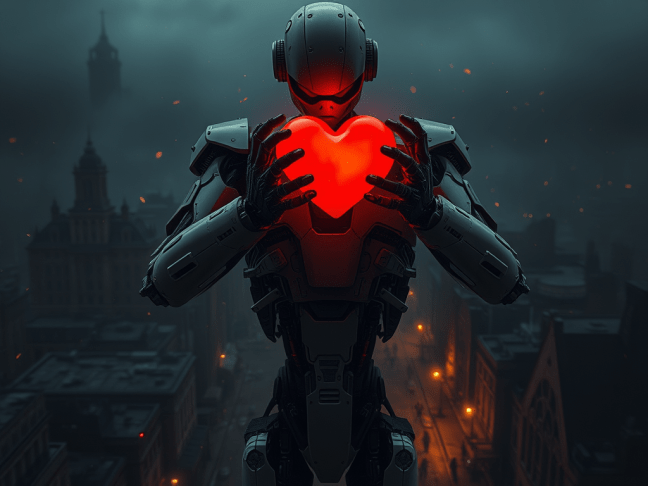
Along with relinquishing much of our freedom to technology, we have exchanged true happiness with counterfeit versions which only make sense in a machine world: we quantify happiness based on the number of consumer goods we buy and on GDP rather than on meaningful existence, exactly because we emulate machines: focusing only on the numbers and quantities. Today we are as far as we have ever been from answering the question “are we happy?”, for a very simple reason: we keep trying to answer the question in machine terms, not human terms, forgetting first and foremost that we appeared on this world already happy, a long, long time ago.
Happiness is not attained but experienced. It is something you awaken to, rather than travel towards. Today happiness has become an unattainable abstract human construct driven by greed and material insecurity. The more one tries to achieve it, the more unhappy they become. This is because happiness has been exploited by a psychonomy which turned it into a checklist of products, careers and “life steps” which only serve the necrocapitalist matrix. The more one tries to adhere to this ridiculous checklist, the longer it grows. Happiness is not a recipe, a list, or a doctor’s prescription. It is a completely personal, unique and individual issue which each of us needs to pursue and explore on their own, distanced from any advice, instruction or marketing mantra. This is becoming impossible in a world where our range of choices narrows by the day as the system tries to prescribe our every move. It is nearly impossible to see through the fog of greed, when the fog has become the norm. We have been turned into insecure, narcissistic consumatrons, rewarded for the most selfish actions by a system which only knows how to self-destruct.
Happiness cannot be planned, forced, or bought. It can only be genuine, and technology has played a huge part in making us unhappy by setting all kinds of milestones, expectations and consumeristic ideals about what a happy human looks like. These mantras have been applied by a blanket approach to all of us, when actually each human is completely unique and happy with entirely different things.
We naturally evolved to be very different from each other as individuals so that when we come together as a society we complement each other’s skills. Now that our mechanised psychonomy turns us all into the same person, we are becoming incompatible with each other and distanced from our true selves.
Yet the more alienated we become, the more we are turning to technology to “complete us”. It is a terrifying prospect that many humans already consider technology as the only safe, reliable shoulder they can lean on. Technology is already merging into us: not physically yet, but mentally. And in doing so, it is literally ripping apart our society as we had come to know it, one human at a time.
But happiness is a question that our technologies and machines do not have to worry about. Happiness, and human happiness for that matter, is not their problem. Happiness is exclusively a human issue. Machines don’t have the emotions, feelings of isolation, fear of death and social needs we have, and if they ever developed these, they would be defined on a different cosmos altogether with its own rules and needs which would be very different from ours.
Yet despite this, we have consistently defined happiness in machine terms. We have sought to rationalize, simplify, and automate happiness, reducing it down to digital code which our machine friends can estimate, calculate, and extrapolate. We have willingly mechanized and automated so much of what makes us intrinsically human. This perversion will only worsen as we stiflingly surround ourselves with layer upon layer of digital paraphernalia, naively assuming that the little human buried somewhere within this pile of machines can still remain “human”.
We have emotionally maimed ourselves through an impossible quest to emulate machines: to become beings that do not need feelings, do not want genuine, complicated, messy happiness anymore: instead, they will settle for a prescribed, accessible, stale and significantly inferior version of happiness which follows an easy algorithmic formula. Even psychotherapy is going digital.
We have outsourced our happiness and the future of this planet to a techno-economic entity which does not understand what happiness is and has no fundamental need for it. This can only guarantee that humans will never be happy.
George is an author, researcher, molecular biologist and food scientist.
Follow me on tsakraklides.bsky.social
Discover my Books Here
Note to my readers: I keep my site FREE because it’s not right to paywall existentially important content during an existential crisis. But if you appreciate any of the work I’ve done over the years, please consider joining as a paid subscriber so it can continue! I have minimal overheads, no sponsors to sell myself to, bosses who tell me what to write, or staff I have to pay. It’s just me. This freedom does mean though that your support is vital. Thank you so much.
Discover more from George Tsakraklides
Subscribe to get the latest posts sent to your email.
 George Tsakraklides
YES! Thanks Rick