
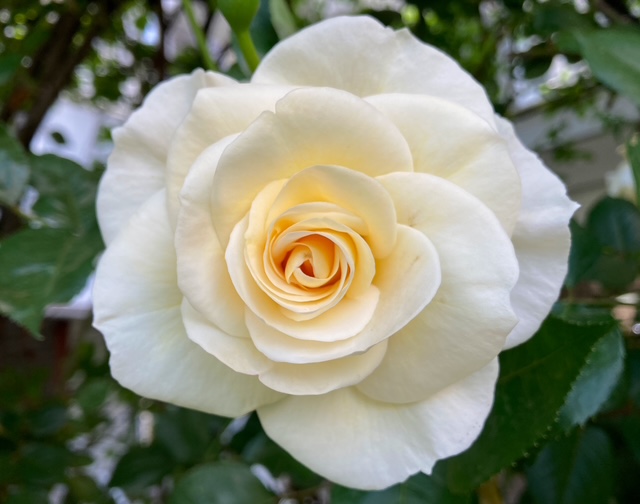
I must have been 8 years old when my father and I kneeled on the dirt and tore open a small, clear plastic bag with a cheap, generic drawing of a white rose printed on it. Inside, there was a dried-up brown/black wooden stick, slightly longer than a pencil. “This is a rose” he said, then pointing up towards the first-floor balcony of the ugly cement apartment block we had just moved into, he said: “it’s gonna climb up there one day”.
I looked at him with complete disbelief, then I looked up at the balcony. Then I looked back up at him again, this time with the faith and trust of a child. If my father said that this dried up stick was a rose, and that it would do all that, maybe he’s right.
The year was 1982. I remember us digging the hole together and planting the stick in the ground. The soil, if you could call it that, was a mix of crushed brick, leftover cement, asbestos and pulverised shards of the local granite rock that must have been dynamited numerous times during the building’s construction. As for the planting site itself, it was in a dark, deeply shaded corner secluded from light throughout the day, in all directions but East by three-storey-high apartment blocks. This was no place to plant a rose. But it was damp, and quiet. And miraculously, the damn thing sprouted.
I have almost no memories from the garden from the 38 years that followed. I never went down there, even though it was right outside my bedroom window. The common problem with communal gardens is that they become neglected exactly because no one has 100% complete ownership of them. They become an unloved, “no-man’s land” full of miscellaneous zombie plants vegetating through neglect and rejection by the very people who brought them there.
The truth is that when I was young, I always found this garden a deeply depressing place, exactly because every time I looked at it, all I saw was abandonment. I never checked into the dark corner down there to see whether the rose was growing, or if it was even alive, partly because I feared that if I looked, I would simply confirm its death. I guess I had already given up on it. It was an ugly dark corner down there, besides, invasive plants like Vinca major and Hedera helix brought back from a mountain trip soon took over the area, turning it into a jungle. There was even a wild plum tree that had grown right where the rose was, so it was difficult to make anything out in this mess. But sure enough, the rose was still there.
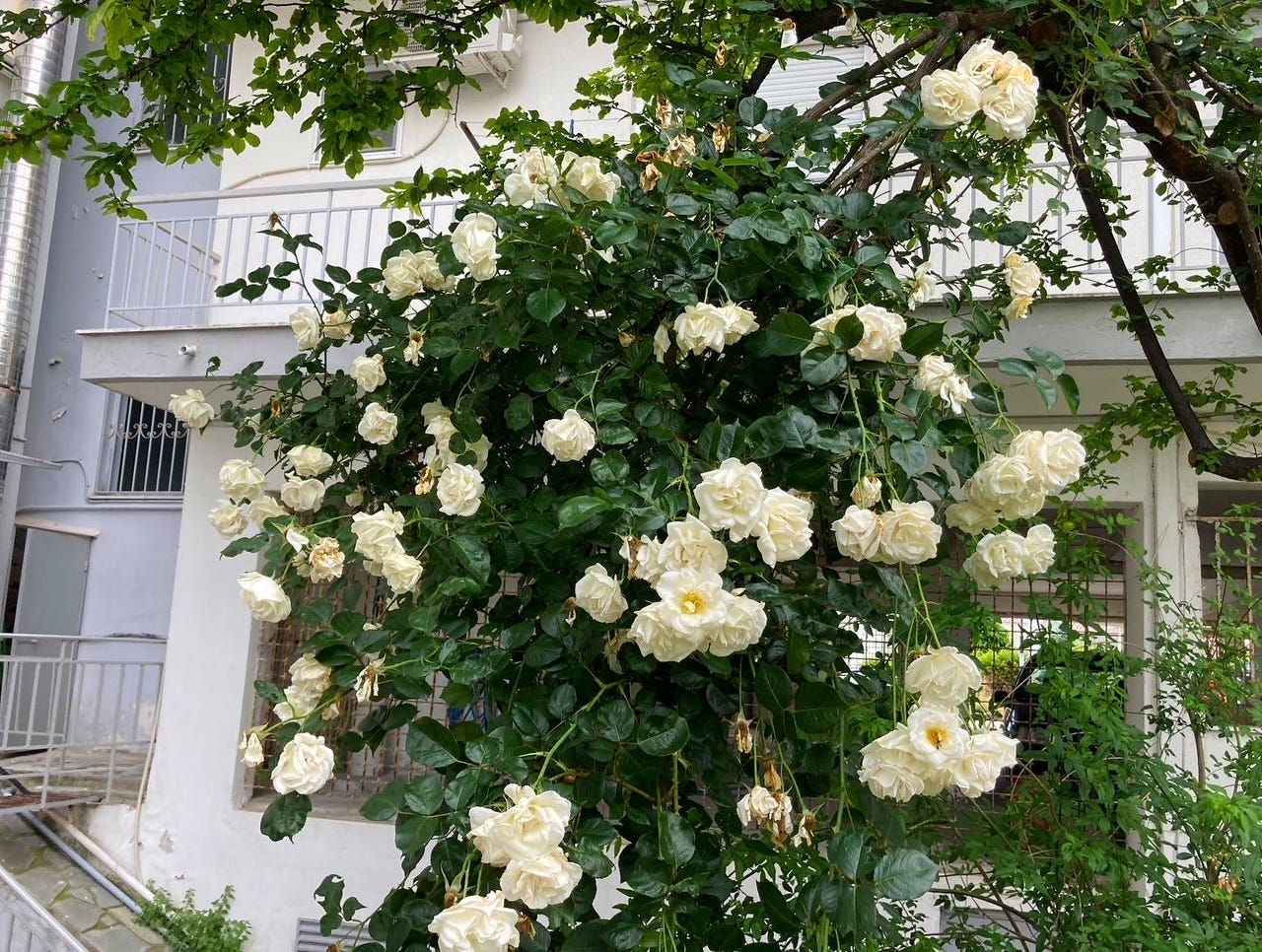
I left the country in 1992 for 30 years, for study and work. According to my mother, at some point the rose did make it up to our balcony, but it was cut back because “it was a threat to the paint”. My father passed away in 2012. The rose remained but, knowing that it wasn’t allowed to climb up to the balcony, it started talking to the plum tree. Together they formed an alliance and decided to support each other in this otherwise dreary, dark corner. It turns out that plum trees can perform quite well in the shade. Likewise, some roses, especially climbing roses like this one, are also highly shade tolerant. In the wild, they are meant to climb onto trees and grow upwards, eventually emerging through the canopy and into the light. They are incredibly resilient plants that can live for centuries.
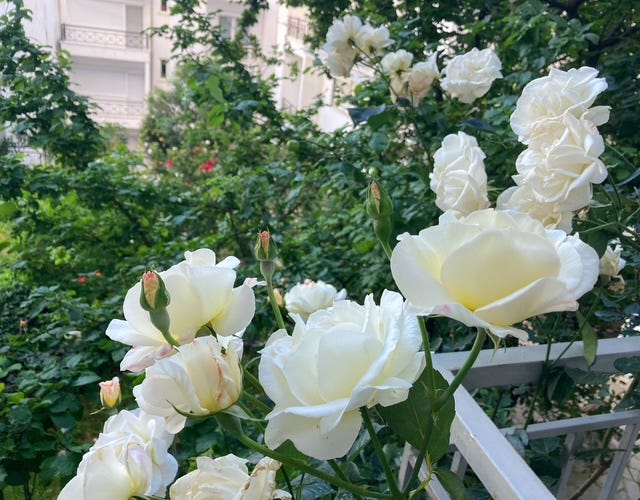
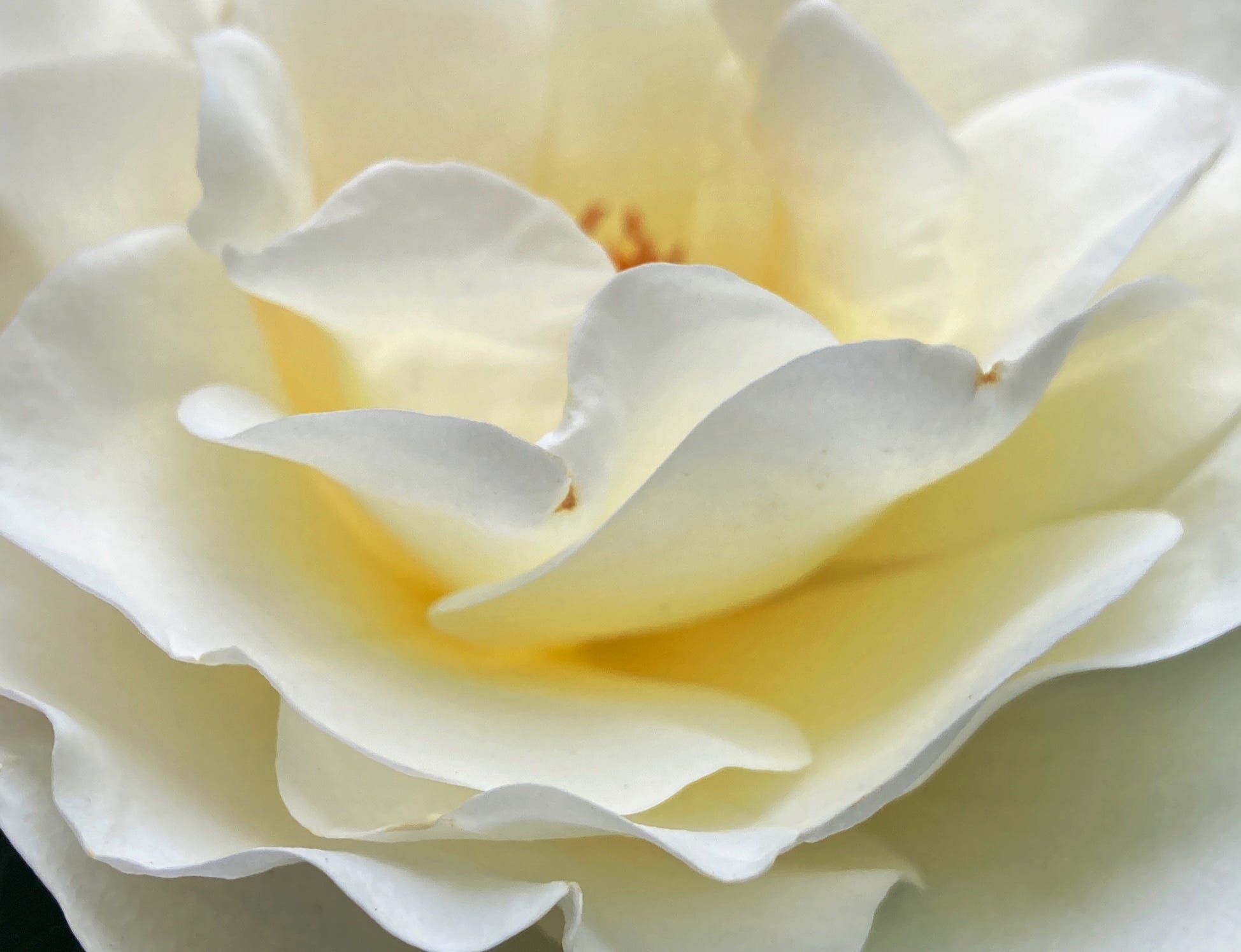
Around 6 years ago, and after a gruelling career in marketing that had left me lost, alienated and almost brain dead, I started spending more time back here at home before moving back permanently, to switch gears into writing and gardening. The plum tree and rose were still here. They had grown old together, their crusty old trunks entwined at the base into a beautiful sculpture that told a tale of hardship, resilience, patience, partnership, community, and courage, so much courage. I started taking care of the rose, 44 years late, and encouraging it back to the balcony. It didn’t take long before the first cane latched onto the balcony again, decades after it had been banished. Having access to more light up here, it now rewards us with the most beautiful, picture-perfect scented roses throughout the year. They are the type of rose you see on old greeting cards: white with a buttery centre, perfectly shaped and flawless, each and every one of them. The plant may produce thousands of them each year, but it takes meticulous care to ensure that every single one is perfect. I don’t know how it does it.
It is an ongoing challenge for me taking care of this rose, because it has grown so large. The majority of its trunk disappears into the plum tree where it splits into two main parts: one that climbs up and through the canopy, and one that traverses the tree and emerges through the other side, where I’m trying to encourage it onto an arbour. A third section, the most recent growth, climbs up to the balcony, and this is the most vigorously growing part. All in all, the rose now takes up an area equal to a city block. Most of its canes are beyond reach and I would need a crane to be able to get up there for an annual pruning and cleaning service. I can only clear the dead branches I can reach from below, and this helps to maintain its vigour.
When my father’s condition suddenly worsened, I was abroad. I delayed coming to visit him because work was busy and I only made it to the hospital when he was already on life support. He saw me walk into the ER room but he couldn’t talk as his breathing was hooked up onto a machine. I couldn’t talk either, there was too much going through my head to even utter a word. I was vocally paralysed, probably at the most important time in my life when I needed to say something, anything. I failed. He passed away a few days later – we got a call from the ER in the middle of the night.
My relationship with the rose had been as dysfunctional as my relationship with my father. I know that he loved me, but we never managed to connect. That moment when we planted the rose was in fact one of the very few times we had ever done something together. The reason I never checked on the rose all these years was not because I had forgotten about it. It was because I had been feeling bitter about my relationship with my father, and it was too painful to be reminded of what that relationship could have flourished into. I was afraid to explore my own feelings of anger, neglect and emotional vulnerability that the rose had become a symbol of. Perhaps if I had sorted my feelings on time, I would have seen our mutual mistakes, and I would have been able to find the words to say goodbye to my father in the ER room.
Although the rose symbolised a relationship that never managed to thrive, the rose itself did, eventually. Deprived of the care it needed when it was young, it went its own way, disappearing into the plum tree where it finally found the love and support it never had. One day when I was pruning it, I got really badly stung by one of its thorns. A vibrant, wine-red drop of blood appeared on my skin, soon growing into a moody dark purple blob that ran down my finger. I looked up into the tangled mess of branches I had been trying to clear and suddenly realised why roses have thorns: they are there not just for protection, but to latch on to other branches and the bark of trees they need to climb. Roses are not villains but relationship builders. They create complex latices by interlocking their thorns and can eventually ascend huge heights with no other support than their own, interlocking branches. They befriend plum trees, walls and balconies, and can ascend for decades before they reach the sunlight. Most of all, they will try again, and again, even after multiple rejections. They will never give up.
We may hate roses when they prick us, but every thorn is actually an invitation to reconnect. This rose is teaching me the lessons life failed to teach me. Like beautiful roses, we cannot expect our connections to be thornless. We should expect to be hurt if we want to thrive. And what we mistake for a thorn is sometimes a desperate call for help. My father may be gone, and this rose may have taken 44 years to reach the sun, but I’m here now, and so is the rose, and the more I become reacquainted with it the more I realise that the rose and I have been leading parallel lives, facing the same obstacles. The rose has become my friend, my therapist.
The plum tree is pretty old now and has taken quite a dangerous tilt, due to the shape it took as it tried to reach the sun. It is quite possible that the next big storm could tip it over. Some of the tenants on the block want to have it cut down as it is a structural threat to the building. Of course, this would also mean that the rose would die with it: their two trunks are so intertwined, it would be very difficult to separate them. But I pray every day, and I cherish every day, every rose. Every time I bleed I know it is because I once left you. But I’m here now, and I’m ready to bleed even more until you take me back. And this time I’m not letting you go, not until the last day you live.
When most everything in the natural world is gone, when there are no more roses, no more trees, who will be there to remind us not to give up? Who will be there to teach us courage?
The oldest rose known is a wild dog rose (Rosa canina) growing on the wall of Hildesheim Cathedral in Germany, commonly called the “Thousand-Year Rose”. This rose bush is believed to be at least ~700 years old, with legends tying it to around 815 AD, soon after the cathedral was founded. It survived centuries of history including destruction of the cathedral in World War II — the roots endured and it regrew after bombing, showing remarkable resilience.
This is a reader-supported publication and my main source of income. By becoming a paid subscriber you can join other readers who are supporting my work and ensuring this newsletter can continue. Thank you so much for all your support.
Discover more from George Tsakraklides
Subscribe to get the latest posts sent to your email.
 George Tsakraklides
You might be able to take some cuttings of this beautiful rose and plant it somewhere where it will be safe from people. Perhaps you can keep it in a large pot so it can travel with you if you move. Roses grow quite easily from cuttings.
Dear George,
Your essays are always worth to be meticulously read, today your letter touched me especially. I lost my father due to a road accident when he was 47 years old. That hour I was hundreds of miles away. So much remained unsaid. He was a wonderful person, as a teenager I didn’t appreciate that. You made me remember today and weep. Good tears though.
Love to you and to your rose and prune tree from Germany
Florian
Dear George,
Your essays are always worth to be meticulously read, today your letter touched me especially. I lost my father due to a road accident when he was 47 years old. That hour I was hundreds of miles away. So much remained unsaid. He was a wonderful person, as a teenager I didn’t appreciate that. You made me remember today and weep. Good tears though.
Love to you and to your rose and prune tree from Germany
Florian
Dear George,
Your essays are always worth to be meticulously read, today your letter touched me especially. I lost my father due to a road accident when he was 47 years old. That hour I was hundreds of miles away. So much remained unsaid. He was a wonderful person, as a teenager I didn’t appreciate that. You made me remember today and weep. Good tears though.
Love to you and to your rose and prune tree from Germany
Florian
Dear Florian, I’m sorry you lost your father so young and so tragically. When we are young we think our life will last for centuries and we take both our life and our loved ones for granted. I hope you don’t take today for granted and you do something to enjoy yourself in memory of your father. Sorry I made you cry, I have been crying all week while writing this essay but it was good tears that should have happened a long time ago. All the best, G
Thank you for this important essay, George! If the plum falls, simply cut the rose as high as possible, it will continue growing again. Never cut close to the ground since it will be a graft on a root stock. If you cut too far down , the root stock will grow as a yellow rose (far from Texas).
thank you Kathleen! all the best, G