
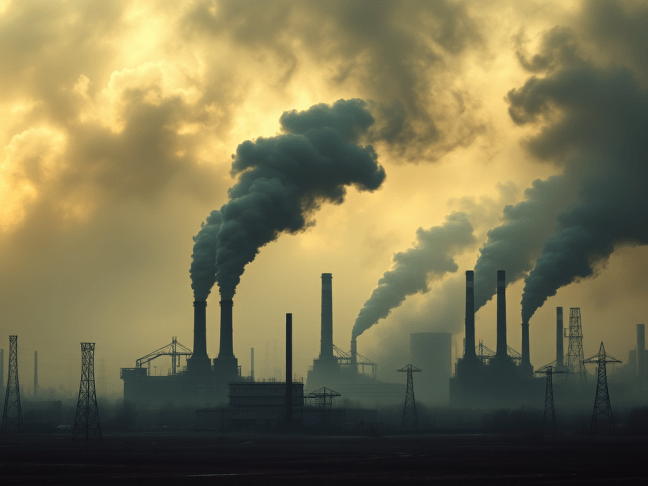
We have been inventing villains since the very beginning of our history. One of the most popular villain narratives in the environmental movement is that everything is the fault of the rich, because they control everything and emit the most. A statistic that is usually thrown about is that 100 or so corporations are responsible for 71% of global emissions. While this demonstrates the economic might of the rich, and the level of inequality in this world, the statistic is completely misleading.
Rich people would not exist if it wasn’t for us, the “poor”, supporting them: buying their products, using the energy they sell us, working in their companies and supporting their businesses. They would not emit what they emit. The 71% figure is emissions that the rich and the poor injected into the atmosphere TOGETHER.
You might have also run into the slogan “let’s eat the rich”. Fine, I’m all for it. The problem is that if we removed the rich tomorrow, new rich would spring up the morning after simply because this economic system runs on inequality and greed. Inequality may be administered and driven by the rich, but it is not caused by them. Inequality in resources has existed before we even had societies. It is caused by an entire society that has learned to generate wealth by exploitation and natural destruction. The “poor” are active participants in this system. They may inflict much less damage per capita, but on a cumulative basis their negative impact is immense due to their sheer numbers compared to the rich. Their impact is absolutely massive, yet it is routinely ignored by environmentalists who want to create simplistic narratives of “good” poor people vs the “bad” rich people. We all fucked Earth up together. Look at yourself, and all of the unsustainable things you have done today, and stop trying to find easy blame on a villain.
The problem is not the 1%, but the 100%. It is ironic that a species which prides itself for its science, technology and rational thinking is incompetent of the simplest math: its overpopulation problem. We can never have net zero emissions with a net 8 billion population of increasingly tech-dependent, energy-hungry humans. The math has already been done, and 8 billion people is too many, even if we all became poor, installed solar panels, and grew our own veggies. Our modern lifestyle, whether we are rich or poor, is propped up by the very unsustainable industries which made our population mushroom to 8 billion almost overnight. But the urge to breed is too strong to resist even among those who know well that their yet unborn children will experience a living hell. Perhaps they will experience this hell together with their children much earlier than they expected.
It’s not just the 1%, and it’s not just fossil fuel that is the problem. It is all humans, and all human industries. In other words, our civilisation. It is clear that civilisational downsizing is long overdue on all fronts: emissions, population, ecological devastation. Humanity can only continue to exist if it uncouples itself from growth of all types: economic, population, and energy demand. As long as we continue to ignore the elephant which no longer fits in the room, we will seek help in the wrong ideas, people, and technologies. As long as this civilisation remains a for-profit industry it will always pursue growth in demand, vulture capital, promises of “prosperity” and investment in technologies that create more emissions than they remove. As long as CEO bonuses depend on year-on-year financial performance, so-called renewables will continue to be implemented in the most dirty, wasteful, carbon-intensive and profit-motivated manner.
We need to completely shift from spending our time and energy achieving, doing and building, to finding ways of undoing, simplifying and deconstructing our previous generations’ so-called “accomplishments”. Rather than building more “stuff”, we should be tearing down what already exists.
The poor may claim to be powerless, but this is not entirely true. Where there are numbers, there is power. And there are many more of “us poor ones” than there are of “them”.
George is an author, researcher, molecular biologist and food scientist.
Follow me on tsakraklides.bsky.social
Discover my Books Here
Note to my readers: I keep my site FREE because it’s not right to paywall existentially important content during an existential crisis. But if you appreciate any of the work I’ve done over the years, please consider joining as a paid subscriber so it can continue! I have minimal overheads, no sponsors to sell myself to, bosses who tell me what to write, or staff I have to pay. It’s just me. This freedom does mean though that your support is vital. Thank you so much.
Discover more from George Tsakraklides
Subscribe to get the latest posts sent to your email.
 George Tsakraklides
Sure its ‘economic growth which is killing us’ and all DNA life. This has been known for ever. Its only rampant now because libertarian fascistic political socialists want to be part of the predacious eradication process blaming the 1% on those who take a bigger share of the cake and as such plague all to be as consumertrons in their own mold.
This is our Nemesis. We are an ersdicatory species GT. Get use to it and..
NM.
Sent from my Samsung Galaxy S9+ – Powered by Three
Sent from Outlook for Androidhttps://aka.ms/AAb9ysg
we lost our reproductive rights when we overpopulated this planet.
killing advertizement industry and status quo propaganda might be interesting social experiment to see how “we” think without constant dragging in one direction ….
No, sheer numbers do not automatically equate to “power.” Not in nature, not in humanity.
“Voluntary simplicity” has been an idea since the back-to-the land late 60s, but it is a micro-niche. Yeast in the vat do not self-limit to avoid feasting on their waste and thereby perishing, and neither will humanity. Not one piece of evidence shows a capacity to self- govern within ecological limits on the part of h. Sapiens.
Do you think it is too late now to solve these problems, or using green energy could have solved our climate crisis if we had started building the new infrastructure in time?
Do you think bacteria in a Petri dish could realize that they are way too numerous and that time has come to downsize for the sake of survival? Humans are not much smarter than yeast, they will eat each other for the remaining resources and then will perish. The way yeast does.
No.
when we downsize human population, then it clashes with individual and reproductive rights. How would you answer that?
moreover, you call this system as psychonomy. So it has created and controlled our subjectivity, then how can you say that poor are many in number. The question are they free to exercise their agency?
An interesting perspective about the population issue seldom seen or heard, within another excellent interview by Nate Hagens:
https://youtu.be/ULn8I1b6vfw?si=AAUjmMFKJvBDDLi2